


She’s a photographer and a flamenco dancer who fights to reduce maternal deaths in poor countries around the world
The difficulties that pregnant women face in impoverished parts of the world can seem overwhelming. But Stacey Ramirez, who has worked for years to improve those conditions on three continents, calls herself “a hopeless optimist.”
“I have to believe that we can get to a place that is beautiful for all of us,” she said. “It’s a guiding force of mine.”
The 60-year-old Nob Hill resident is executive director of the Global Pediatric Alliance, an international nonprofit focused on maternal healthcare in Mexico and Guatemala. Since 2014, she has worked to reduce maternal deaths by supporting indigenous midwives, combining ancestral knowledge with modern medicine, and addressing barriers such as poverty, geography, and education.
Speaking four languages
Born in Spain to a U.S. military family, she grew up speaking Spanish and English at home and learned Portuguese and Arabic as an adult. She became enamored of flamenco dancing during a trip to Spain and later learned to perform it professionally.
She trained in journalism and ran a training program for photographers in Cuba. But she devoted much of her career to improving healthcare for mothers and their children in impoverished parts of the world. She has also engaged in varied humanitarian work in places such as Bangladesh, Liberia, Jordan, and Lebanon.
Based in San Francisco, the 22-year-old Global Pediatric Alliance focuses on maternal health issues in rural Latin America. Many of the women it works with are indigenous and don’t speak Spanish; in some areas they face maternal mortality rates four times the national average.
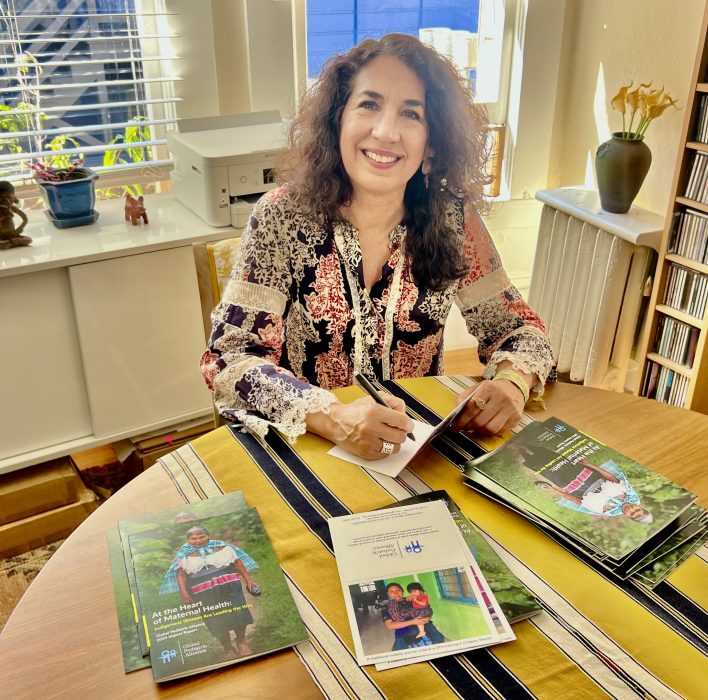
High maternal mortality rates are, for the most part, preventable, Ramirez said. “But there are barriers that (mothers) face based on income levels, whether they are indigenous or not.”
Ramirez said her organization doesn’t directly provide services but rather works with women and girls and midwives to educate them and prepare them to deal with medical emergencies.
“If you have hemorrhaging, if you have hypertension, it’s being able to get from the stage of realizing you need to get to a hospital to actually getting to that hospital, and then once you’re at the hospital, to getting the care you need.”
Midwives are invaluable
Midwives, she said, are key to resolving many of those issues. “They are the essential healthcare workers. We work with them to enrich their skills. It’s mixing the ancestral knowledge with Western medicine and acknowledging that the midwives are the caretakers of women’s health in these communities.”
Ramirez said she finds this type of work immensely rewarding. “You know, if there’s a way that I can help other people, especially when you see their problems can be solved, it can change people’s lives. I want to do that if I can. I want to try.”
Her parents were born in South Texas, her father in a one-room house with a dirt floor. He was the first in his family to go to college and then joined the U.S. Air Force and became a lawyer.Her mother worked as a flight attendant, but the airline forced her to quit when she married.
Ramirez’s parents believed in education; college was always on the agenda for Ramirez and her two sisters and brother. She graduated with a double-major–a Bachelor of Arts in Spanish and journalism from the University of North Carolina at Chapel Hill in 1987. But she wasn’t ready to pursue a conventional career path.

She spent a semester in Seville, Spain, during college and fell in love with the art of flamenco dancing. She planned to return to Spain after her senior year to study dance. “But I didn’t tell anyone, because I was afraid that I would be talked out of it.”
It was a bold choice for a young woman who had never taken dancing lessons as a child. She even failed when she tried out for cheerleading in high school. “I think we were supposed to do a split, and I did my split and toppled over.”
By early 1988, she had saved enough money to return to Seville and enroll in a flamenco academy. “I knew nothing. And I bought some shoes and a skirt there and started learning.” She studied in Seville for much of that year and then decided to enroll in graduate school in the U.S.
She entered an MBA program at the Thunderbird School of Global Management in Phoenix. When she was accepted, the first thing she did was look to see if there were any flamenco teachers in Phoenix. “And thank God, there were two!”
“So, I started my graduate degree, but I also was taking flamenco classes, and one of the teachers that I was studying with had a dance troupe, and she asked me to perform with her dance troupe.”
Ramirez graduated from Thunderbird in the spring of 1990 and went to work for Univision, a Spanish-language media company, in Phoenix. While there, she formed her own small flamenco dance group. “We called ourselves Lluvia Flamenca: a guitarist, another dancer, and I. We tried to go to restaurants and different places, you know, to perform, to be the entertainment.”
In early 1992, Ramirez moved to Torreón, Mexico, to study with a dance master. He had converted his house into an academy. “So, I stayed in this little room (in the teacher’s home) that had a little bathroom, and I got a little foam mattress for my bed, and I took classes and danced all day,”
Appearing in a telenovela
Six months later, she moved to Mexico City to become a translator for Berlitz. She became a freelance translator in 1993 so she could devote more time to flamenco. At one point, she performed flamenco on a telenovela, a serialized drama popular in Mexico.
She remained in Mexico for much of that decade, helping to raise money for the
Global Fund for Women and later moved to San Francisco, where she worked as a fundraiser for the Hispanic Scholarship Fund.
Photography became a passion for Ramirez. With a professional certificate in photography from Maine Media Workshops in Rockport, Maine, in hand, she journeyed to Cuba in the early 2000s to attend a training program.
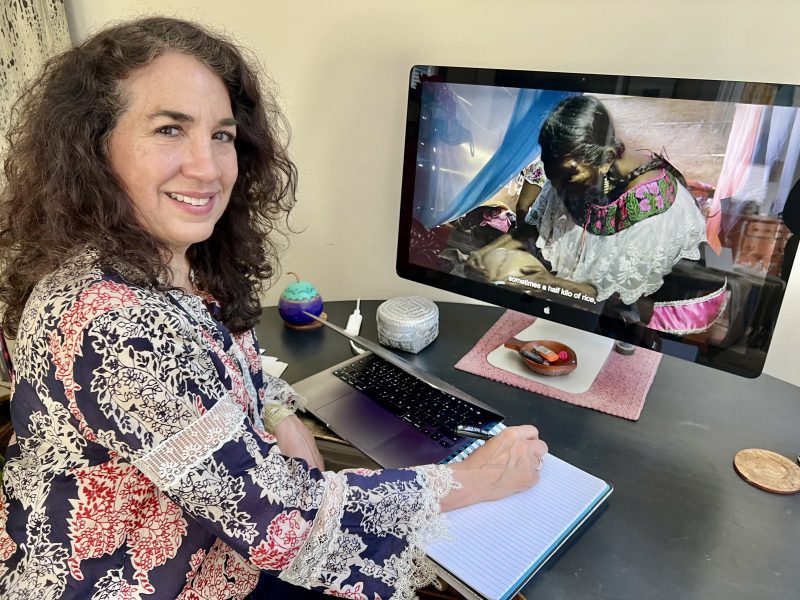
“We were working with incredible people like National Geographic photographers, and photographers who belonged to the Magnum Agency,” she said.
The program took place before the widespread use of digital photography, and the Cuban photographers were conserving expired film since film was in such short supply. Maine Media eventually hired her to be the director of their school in Havana. She stayed there until 2002.
The camera’s eye
“It was really an eye-opening experience for me,” Ramirez said. “For me, photography is more than seeing what is in front of me in a new way. So often it has allowed me to be invited into the world and lives of others, and capture, if for just a second, a bit of the beauty, hope, or desperation of their daily situations.”
Returning once again to San Francisco, Ramirez worked with several human-rights-focused organizations. She was a program administrator for Peace Brigades International and worked with the Institute of International Education, where she trained non-governmental organizations in Jordan and Lebanon in social media. And she oversaw the Baby Basics program for the What to Expect Project in Liberia and Bangladesh from 2013 to 2014. The project targeted literacy training as part of a prenatal program for expectant mothers.
A father’s advice
Ramirez said she’s living out the legacy left by her parents, which has come full circle with the work she’s doing at the Global Pediatric Alliance.
“My dad told all of us we could be whatever we wanted to be, and, essentially, he and my mom worked to give us that gift, and I feel immense responsibility for that. I was lucky. I want to give that to other people.”
Contact author Mary Anne Lewis: maryannelewis@sfseniorbeat.com





Dominic Martello
Inspiring woman.
Melaniea Grossman
Very inspiring! Well written too!