

Successful sous chef finds equilibrium and support after career sidetracked by health and hard times
Jon Insco has been a go-getter most of his life — always hustling for his next adventure.
As a freshman at Gunderson High School in San Jose, he spotted a “Help Wanted” ad for a Denny’s in nearby Los Gatos and walked in to ask about the job. The blue-eyed teen from Aptos, who lived for surfing, cycling, and skateboarding, wasn’t afraid to get his hands dirty if it meant earning money for the gear that fueled his passions.
“I remember the manager telling me he hadn’t had a dishwasher in three days,” Insco said.
“I told him, ‘You’ve got one now.’”
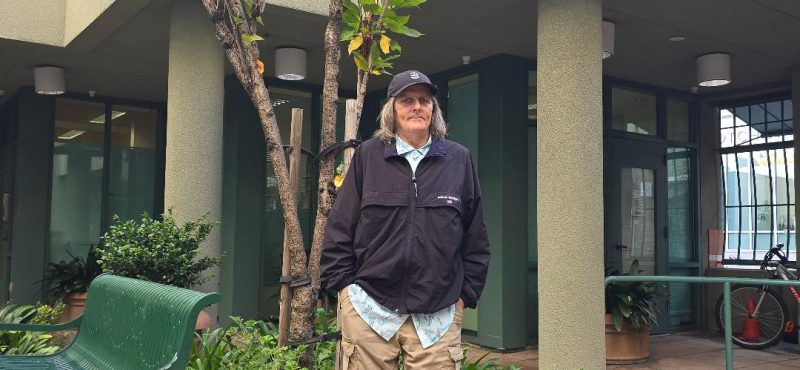
That exchange launched a 41-year career in the restaurant business that saw Insco rise to become sous chef at some of San Francisco’s elite kitchens.
Insco learned to cook as a child because his parents often worked late, he said. His father was a salesman and his mom a bartender. “Alcohol was always in the house,” he added.
When he was younger, his parents encouraged him to go to college, but after high school he decided to pursue his dream of becoming a head chef — against their wishes. His godfather had told him at one point, “you should be a chef.”
Insco had been living in San Jose, unhappily in a job inspecting microchips, when in 1991, he moved to the city to chase his dream of being a sous chef. His résumé includes stints at the former Scala’s Bistro at the Francis Drake Hotel, where his specialties were grilling and sautéing, and sous chef, second in command to the chef, at Zuni Café, one of San Francisco’s top-rated restaurants for the past 30years.
“You’re almost like a low-paid celebrity,” said Insco, now 62. “You get invited to a decent party, and someone asks what you do, and when you tell them you’re a chef at Zuni’s, next thing you know there’s 15 people asking you, ‘Why’s the chicken so good there?’”
Health trumps work
He just didn’t know how little money he’d make. He’s lived alone since 1991, mostly in SROs near Chinatown, South of Market and at one point in Berkeley. He had a girlfriend when he lived in Berkeley, his only long-term relationship.
But decades of 11-hour shifts on his feet, exacerbated by a hip injury, eventually took their toll. A cut on his right index finger that led to it being amputated “was the last straw,” he said.
By 2009, he’d hit a wall and had to stop working.
Insco, just 46, picked up occasional part-time work. He acknowledged that drug and alcohol use were “absolutely” a factor in his declining health and material circumstances. He mostly drank but also used marijuana and cocaine. It was part of the lifestyle for many working in the restaurant industry.
Without adequate savings, he quickly fell into a downward spiral. Within a few years, he was living on the streets. He has since secured stable housing in a single-room occupancy hotel in the Tenderloin, but he has no support system and virtually no savings.
He said he’s been sober for 10 years and lives on around $1,500 a month from Social Security.
He faces multiple health challenges and is awaiting hip replacement surgery. He lost his right index finger to amputation after a non-work-related cut became severely infected. Yet he acknowledges that many seniors in the city have it worse — and considers himself fortunate to have a roof over his head.
“I thank God every day,” he said.
He also feels lucky to find the St. Francis Living Room (SFLR), a sanctuary in the Tenderloin that serves up breakfast at no cost along with a sense of community to homeless and low-income seniors. He is one of dozens of low-income seniors among the 60 to 70 regular visitors to the facility, which is open weekday mornings except on holidays.
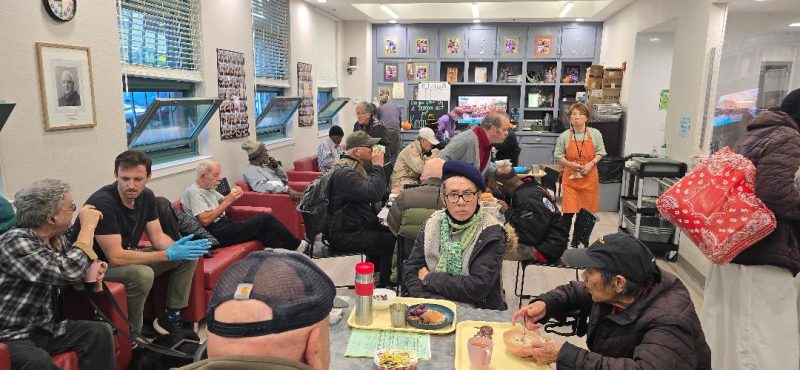
The SFLR was launched in 1987 by Father Alfred Boeddeker, a friar known for his humanitarian work who also founded the St. Anthony Foundation, which operates a dining room and medical clinic. Boeddeker started the SFLR after learning that a number of retired military service members who had moved to the Tenderloin with little money or support were dying by suicide, SFLR Executive Director Pierre Smit said.
“The problems aren’t new,” Smit said. Elderly residents in the Tenderloin “are stuck here, and it’s not safe to be on the street, so they come here because it’s a safe place. They talk with their friends, they relax without worry, and they have a sandwich. And if they need a second sandwich to go for lunch, that’s fine too.”
A troubling trend
Insco’s plight is part of a troubling trend. About one in four people experiencing homelessness in the city are over the age of 51, according to the city’s 2024 Point-in-Time report, and experts say a myriad of factors, including high rents, low retirement savings, and health challenges are likely to exacerbate this emerging crisis.
“Across California, in our cities, suburbs, and rural communities, older renters are facing a deepening crisis of rent unaffordability,” Justice in Aging reported in 2024. “Older Californians living on a fixed income have been unable to keep up with the challenges of rising rents, health care costs, and other basic needs.”
Programs like the SFLR have become lifelines for this underserved and often overlooked population, offering not just a meal but a measure of dignity and routine. And to hear the program’s guests tell it, a warm breakfast and familiar faces can bring a sense of humanity back to people facing challenging circumstances.
“I love it here,” said Maralyn Chan, a 75-year-old retired 411 operator and longtime community activist. “A lot of people don’t have a place to go, and they give them breakfast. They treat everybody good here.”
“And the price is right,” she added jokingly.
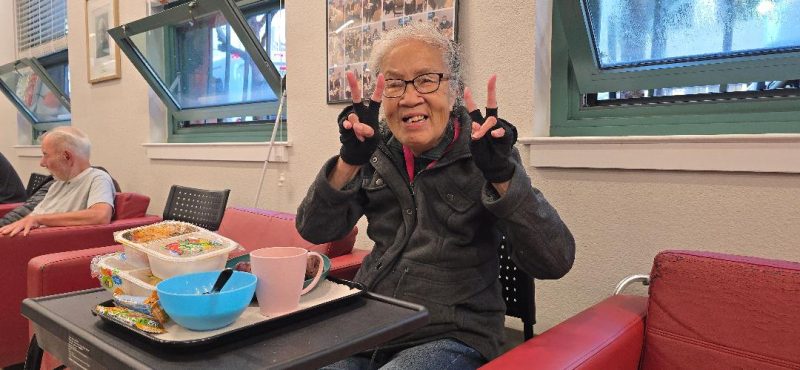
The SFLR relies on a group of volunteers, which on a recent Friday included District 5 Supervisor Bilal Mahmood.
“What’s amazing about this program is that it’s free, it’s fully privately funded, and they’ve been serving the community for a really long time,” said Mahmood, whose district includes the Tenderloin.
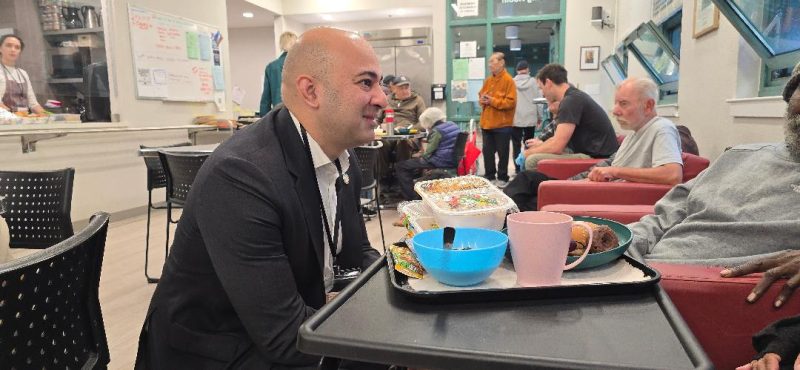
“They support anyone who comes in, no questions asked. There are a lot of seniors in the Tenderloin and across District 5 who don’t have the support network they need. Having a space where people feel safe and at home … especially with the food insecurity in this city … is an incredible resource.”
Not just food
What sets the SFLR apart from other food kitchens is the welcoming atmosphere that encourages guests to come for the food and stay for the companionship.
“It’s more like a living room — they stay here after they eat,” volunteer Mickey Watrous said.
Watrous said volunteering keeps her active.
“You get a good feeling,” she said. “You don’t get anything — no money or anything — but when they smile, or they say, ‘thank you,’ I get more than they get, emotionally.”
For Insco, the SFLR is “like a family.”
“Everyone knows each other. Look around — everyone looks pretty comfortable here,” he said between spoonfuls of oatmeal. “It gets my day going.”
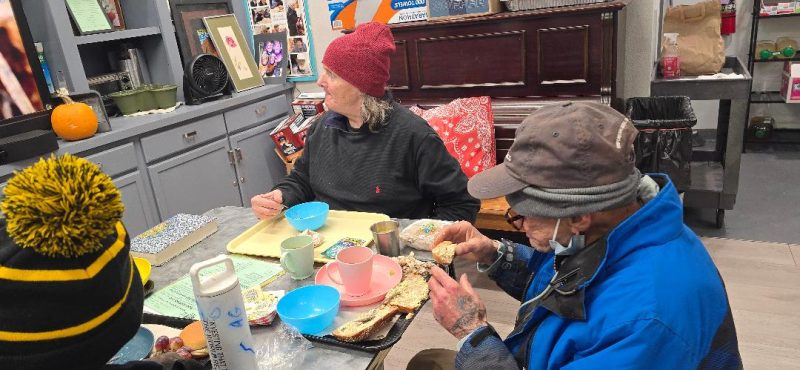
But it isn’t the life he once dreamed of.
“My idea was to come to the city, work with the pros, work with the people in the magazines,” he said, meaning chefs of distinction, such as Judy Rodgers, a five-time James Beard Foundation award winner, with whom he worked at Zuni.
Many of Insco’s high school friends went into what was then a nascent tech industry. “They’re making really good money,” he said. “I don’t even want to repeat how much — it’s a huge amount.”
But a visit to the SFLR suggests that, in today’s world, no career choice makes a person immune to hardship.
Jay, 69, who asked that his last name not be published, is a regular guest. He once held a lucrative tech job but says a series of bad decisions led to his current circumstances. Three years ago, he suffered a stroke.
“I was doing all right,” he said. “It’s just that I got in the wrong places at the wrong time. And when that happens, it’s like Niagara Falls — straight down.”
Being homeless: ‘you get used to it’
Insco is now hoping for a different kind of adventure. He wants to improve his circumstances by moving into one of the city’s senior housing projects. He’s especially drawn to the Coronet on Geary and Arguello because it’s closer to the beach — a place he still visits often to watch the waves that remind him of his surfing days.
Despite his current situation, Insco still beams with pride over his years in the restaurant business, especially his role at Zuni Café. “That place was amazing,” he said.
But he admits he never seriously planned his future.
“I never thought I’d get old,” he said. “As you get older, it seems like time goes by faster. Your 40s and 50s go by really fast.”
Insco was homeless for about a year and a half after he stopped working full time.
“It’s weird,” he said. “You get used to it after a while. You get used to it, but it was tough — especially when it rained. When it didn’t rain, it was no problem.”
Asked what he wants people to know about those struggling in a city awash in wealth, he said:
“I hope they’re more understanding,” he said. “It can happen to anybody — and it can happen real fast. One wrong investment, one divorce, and you can lose everything.”