


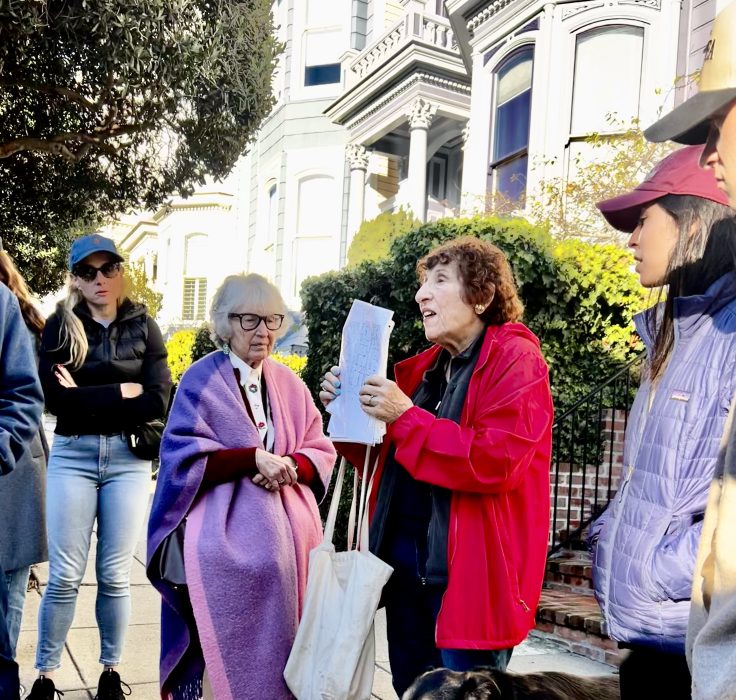
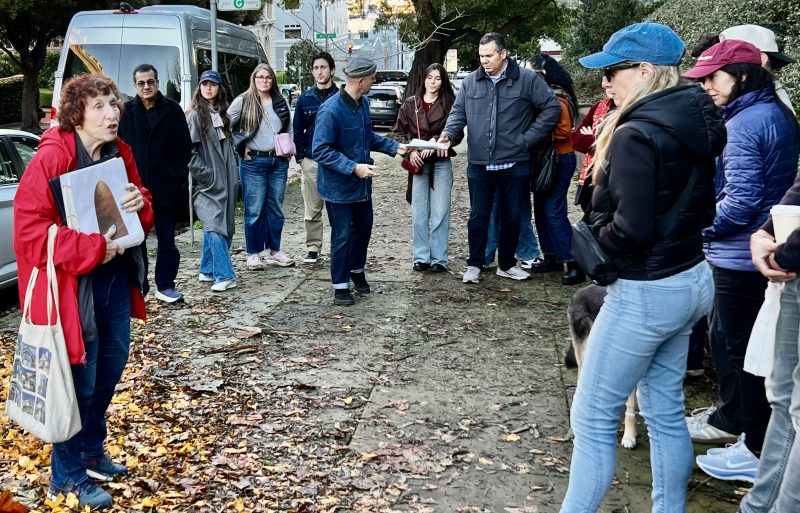
As she strolls toward the smallest park in San Francisco, Bonnie Wallsh calls back to the group of tourists behind her: “How many of you have had a park named after you?”
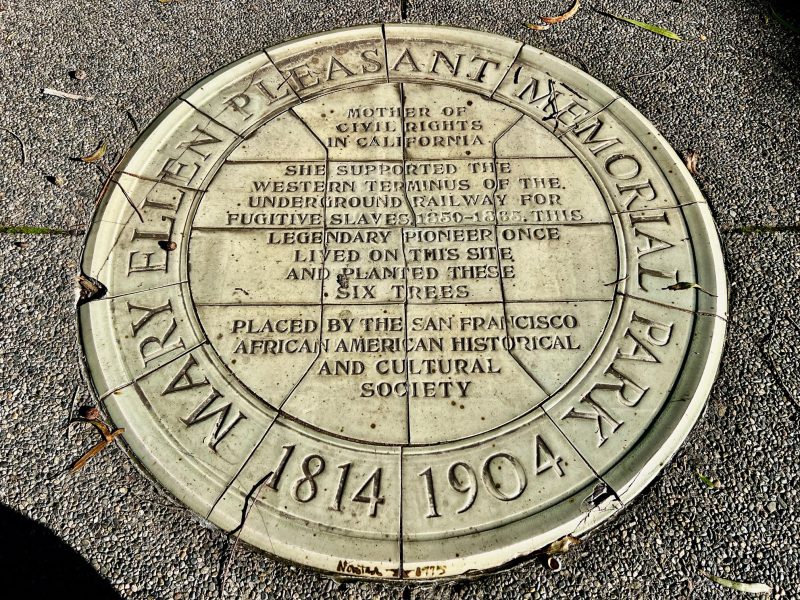
They are standing by a tiny swath of land on Bush and Octavia Streets named the Mary Ellen Pleasant Memorial Park. It’s dedicated to a housekeeper to some of the wealthiest San Franciscans during the Gold Rush era who became what was likely the first self-made millionaire of African heritage. She had a free Black mother and native Hawaiian father.

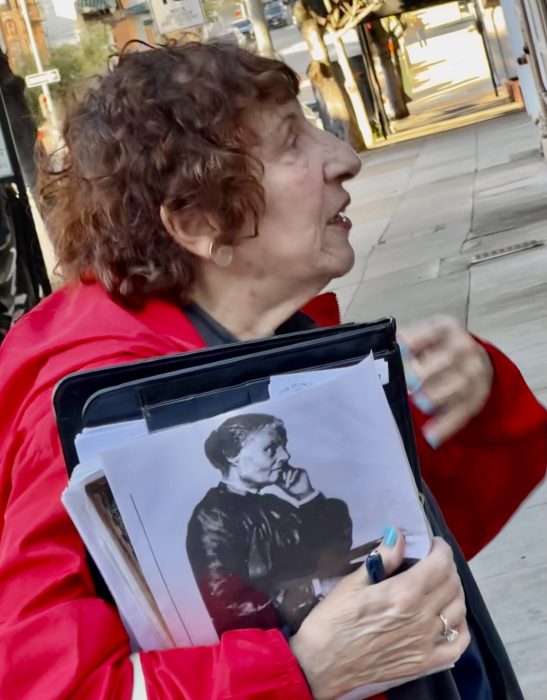
She invested in banks, gold, silver, quicksilver, and property. While continuing her domestic work, she opened laundries and a boarding house. Pleasant was also an abolitionist.
Wallsh is a City Guide who conducts free, twice-a-month tours of Pacific Heights, where she has lived for the last six years. It’s called Victorian San Francisco for the many stately mansions that proliferate in this upscale section of northeast San Francisco.

On each tour, she starts by asking visitors to introduce themselves and what their interest is. It’s her way of warming up their curiosity in San Francisco’s Gold Rush history, which captivates Wallsh as well.
For her, this little-known history seems to even the scales between the white wealthy industrialists and the underclass of this time.
“I love this story,” she said. “Pleasant was a black entrepreneur who married well, made wise investments in real estate and most significantly, founded California’s underground railway to help the enslaved in their struggle to escape their captors.”
She deems it the highlight of her tour, which is loaded with information and intriguing narratives. Wallsh, who enjoys engaging people in the sights and sounds of Pacific Heights, sometimes apologizes for talking too fast, dashing from one subject to another.
“I just love this city so much,” she said. “The history is so rich; ready to be told and retold.”
Stirring up fun

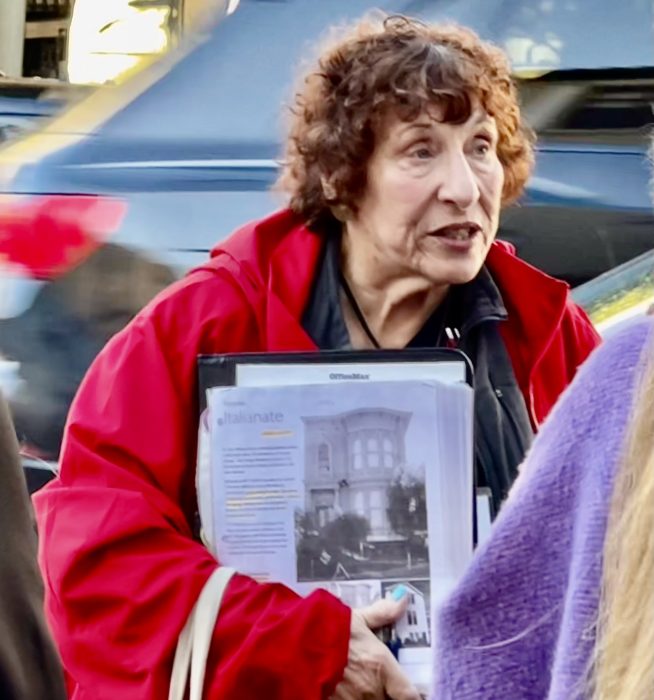
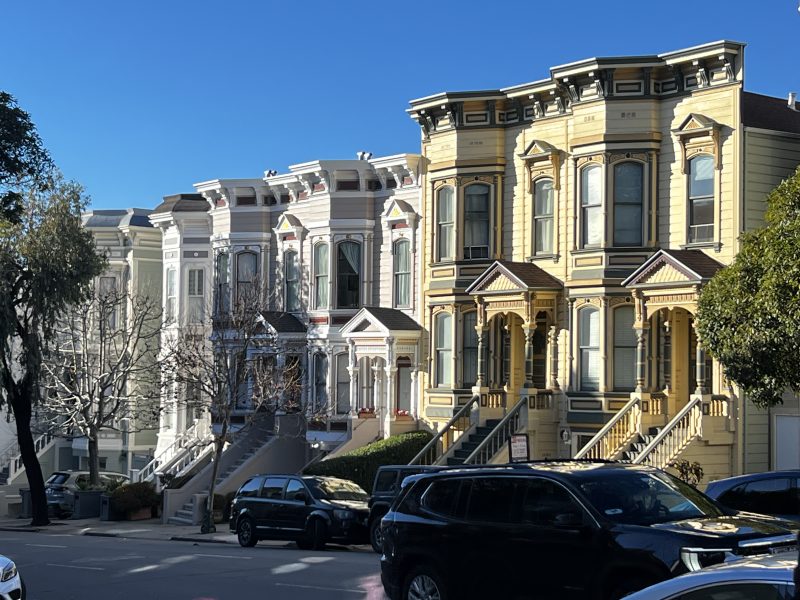
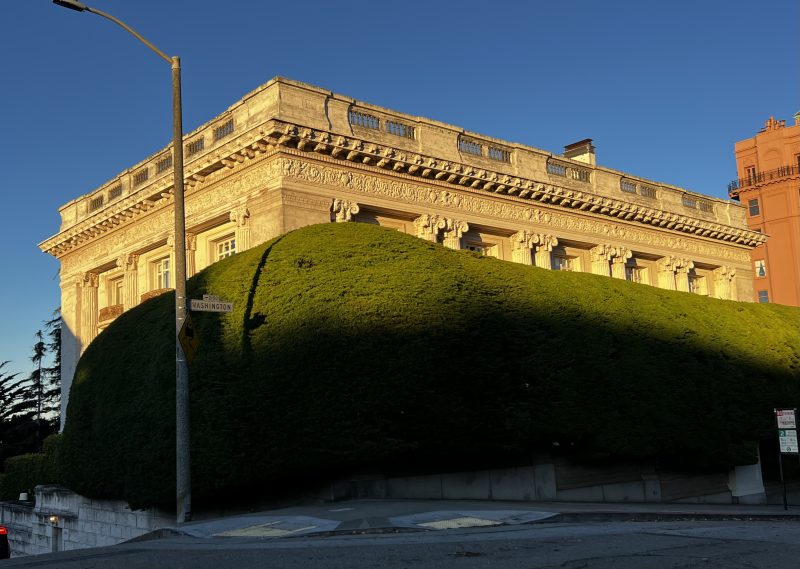
As she points out each historic mansion, describing the three types of Victorian architecture – Italianate, Stick, and Queen Anne – she includes stories of some of the notables who lived in them: Dominga Atherton, wife of the gold rush merchant and trader who founded the city of Atherton; James Phelan, industrialist, city mayor and California senator; and Adolf Spreckels, the sugar magnate. (The novelist Danielle Steel now lives in the Spreckels mansion.)
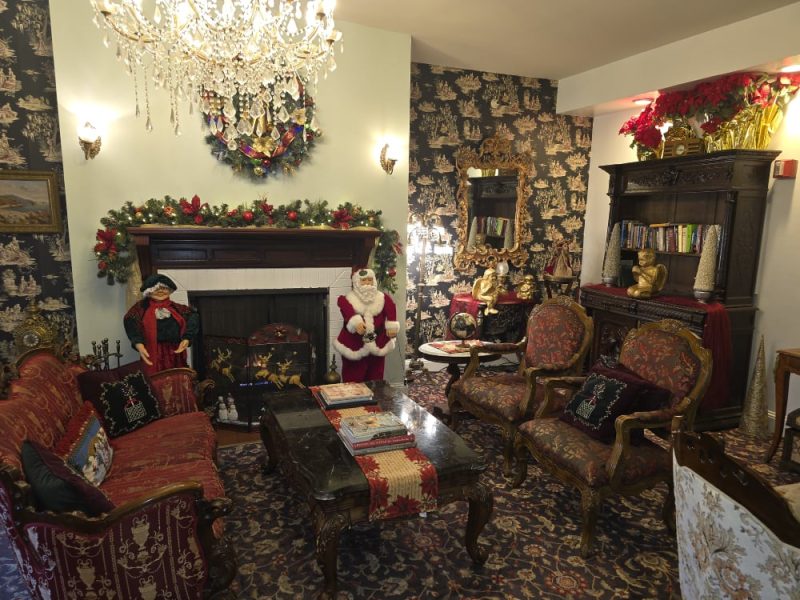
In one of her most recent tours, the attendees were treated to a view of the Queen Anne Hotel lobby, which has been decorated for the holidays with trimmings reminiscent of Victorian San Francisco.
Her favorite part of the tour is making contact with each visitor. She likes what writer Maya Angelou said: “People will forget what you said. People will forget what you did, but people will never forget how you made them feel.”
Just to stir up some fun and laughter, she quizzes everyone after the tour and then hands out candies and magnets as prizes.
“I love meeting people from all over the world and learning about different cultures. My travel experience and knowledge of geography hold me in good stead when I meet tourists in San Francisco, and I view myself as an ambassador of the city which I now call home.”
Best layoff ever
It was an unexpected layoff, due to budget cuts, that led to the career that would sustain her: meeting and conference planner. Wallsh, now 80, owned and operated her own consultancy, and taught the art and science of meeting planning at seven universities, including the University of North Carolina, New York University and Virginia Tech. She has also written articles for travel publications on the best tips in conference planning.

After graduating from college in New York City, she became an educator, teaching sixth grade and then high school social studies in 1976.
“Getting laid off as a teacher was the best thing that could happen to me, although I didn’t realize it at the time,” she said.
Unemployed, married and needing to pull in some income to pay for necessities, she puzzled about her next step. She walked into a travel agency in New York City and asked for a job — on the premise that she was curious about geography and liked the idea of traveling the globe.

She was hired immediately, working strictly on commissions. Along the way, she enrolled herself in a one-week course in being a travel agent sponsored by the former Trans World Airlines.
Serendipitously, she won a free cruise to the Bahamas, with the expectation she would be promoting the experience to others. She paid only the $9.56 port tax. For a few extra dollars, she was able to get her husband on board.
Stroke of luck
By 1980, she had begun thinking about creating her own livelihood. It became serious when her husband, Maurice, a social worker got lucky in a card game. “He won $100 playing blackjack and handed me the money to start my own event management business,” she said.
On a whim, she enrolled in a six-month course given by Meeting Professionals International in New York City in 1986. She got a CMP (certified meeting planner) and later a CMM (certified meeting manager).
Up until two years before she got those certificates, the business of budgeting, organizing and staging events, conferences and meetings had been done by secretaries, office managers and manual laborers. But the growing size and complexity of these events prompted the creation of the CMP, CMM and other meeting specialty certifications.
Armed with both those credentials, she ran Bonnie Wallsh Associates LLC for 40 years, with three associates in an office on Staten Island.

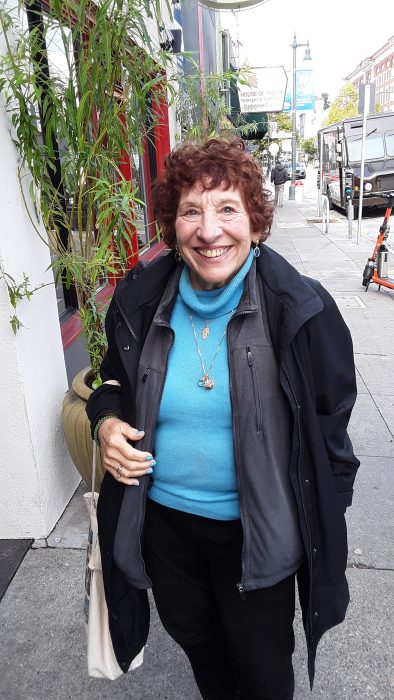
“After a few projects, I was able to build trust relationships with stakeholders in the association and corporate orbits.
One of her largest contracts was the 1992-93 Council of Jewish Federations conferences, with 20 organizations and more than 3,000 attendees at events in New York and Montreal. Keynote speakers at this “General Assembly” were Israel’s Prime Minister Yitzhak Rabin and Vice President Al Gore.
The planning tasks were multifarious: program design and development, budgeting, food and beverage, logistics, and audio/visual, signage, and printed material development. In addition, she said, “There was extreme focus on security, working closely with the U.S. Secret Service and Israel’s Mossad. “Everything worked without a glitch.”
After living in New York for most of their lives, Wallsh’s husband decided that North Carolina would be a good move for the both of them. He had visited and found the cost of living more affordable and the quality of life more compatible. The Jewish community was well established in Charlotte, and he knew what synagogue they could join.
The move was one of her most emotional experiences, she said, other than the break from teaching to self-employment. So many friends and belongings to leave behind; the roots were deep and rich.
Making a new life
She moved to San Francisco six years ago – her husband died in 2005 – to be closer to her daughter, who lives with her husband in the Mission District. Since then, Wallsh has been diligent in making a life for herself here in San Francisco. She’s in close touch with her daughter and unmarried son, who lives outside of Atlanta, Georgia.
She joined the Sherith Israel synagogue, as well as its book club and social action committee. She has taken several classes at the Fromm Institute, does water aerobics three times a week, and plays Mah Jongg at the Congregation Beth Shalom.

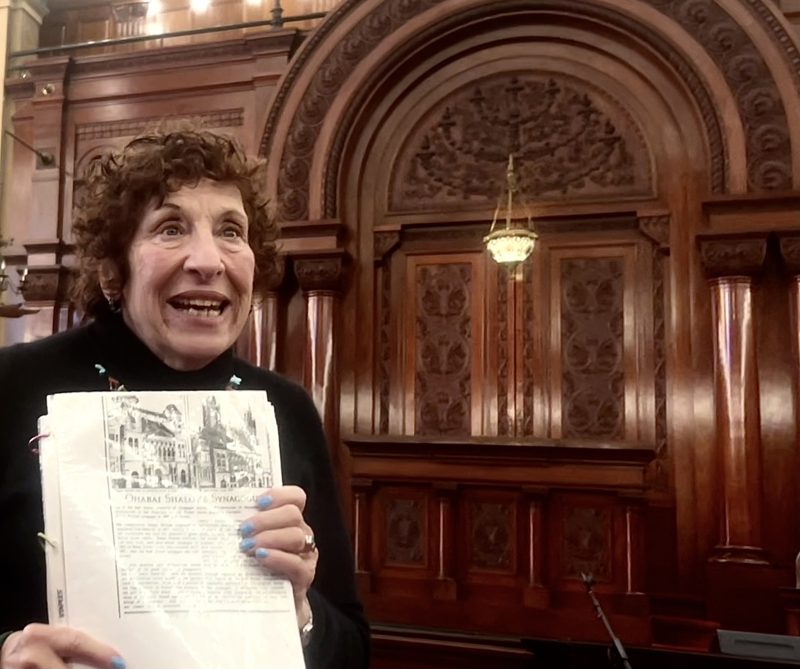
Wallsh, who has visited about 40 countries over the course of her career, has never lost her enthusiasm for new places and people. Next year, she plans to visit Montenegro, Bosnia, Herzegovina, Slovenia, Morocco and Italy.
“My father inspired me with his love of travel. No matter where we lived, we had a map of the world and another of the USA on the wall,” she said. “Also, I just loved the subject of geography.”
And it was her father, she said, who set the tone for her audacious jump into a career that at the time was in its infancy. He was one of the first men to seek a career as a registered nurse in the ‘40s, when it was considered a woman’s job. He retired in the ‘70s.
“My father was instrumental in helping me become who I am today,” she said, noting that he helped break the code in nursing.