

Stephanie Ernst-Scott runs the last tackle shop in San Francisco. It’s been in her family for 60 years.
Walk through the doors of Gus’ Discount Fishing Tackle, and you’ll likely be greeted before you even reach the counter.
That’s how Stephanie Ernst-Scott learned to do business from her father, Gus Ernst, who opened the Outer Richmond shop more than 60 years ago.
“You say hello to somebody when they cross your threshold,” said Ernst-Scott, an energetic 75-year-old woman with curly auburn hair.
“They’re doing you the honor of coming into your establishment over somebody else’s. That was the first work thing he ever told me, and I still do it.”
Gus’ Discount Tackle has been part of the Outer Richmond long enough that some customers who remember coming in as kids now bring their own children to the store. Ernst-Scott operates one of San Francisco’s last remaining bait and tackle stores.
A native San Franciscan
Ernst-Scott attended George Washington High School and is a lifelong Outer Richmond resident, she said.
Located between 38th and 39th Avenues, Gus’ is one of the few remaining non-restaurant businesses along a gentrifying stretch of Balboa Street. While many long-term businesses on this block have closed their doors, Ernst-Scott’s shop has remained a constant.
Asked whether running the store has gotten more challenging over the years, Ernst-Scott said it hasn’t become more than she can handle. “It’s challenging in a good way,” she said.
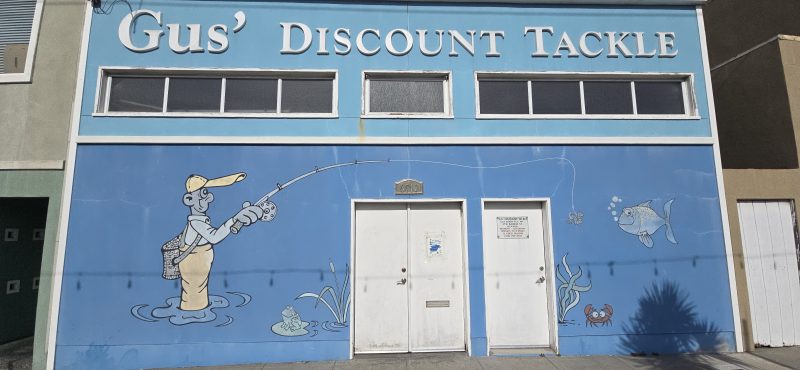
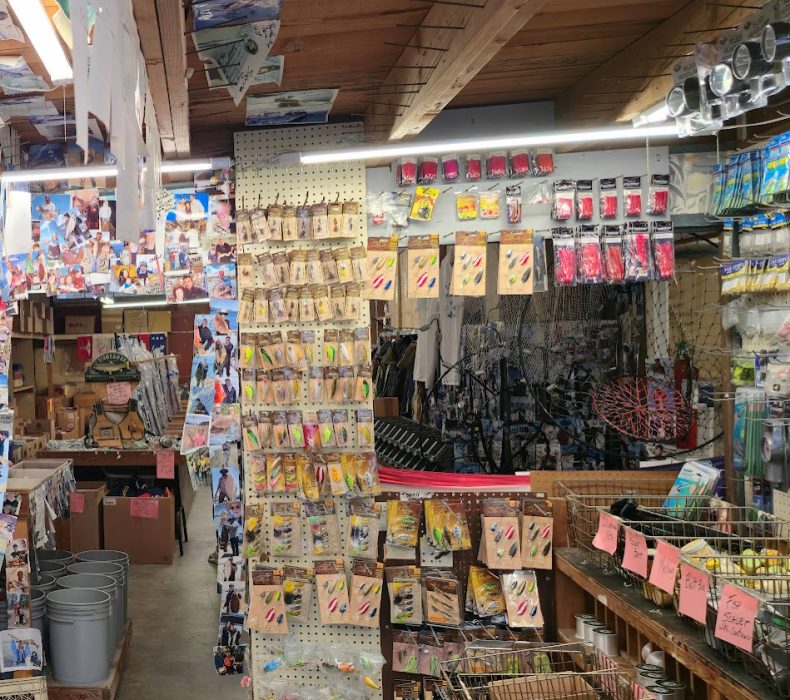
The small, baby-blue storefront is painted with a cartoon-style mural showing a fisherman, fish, and a crab, with a fishing line stretching across the facade. It has no display windows, just a single open doorway. The shop sells rods, reels, bait, crab traps, and other fishing gear.
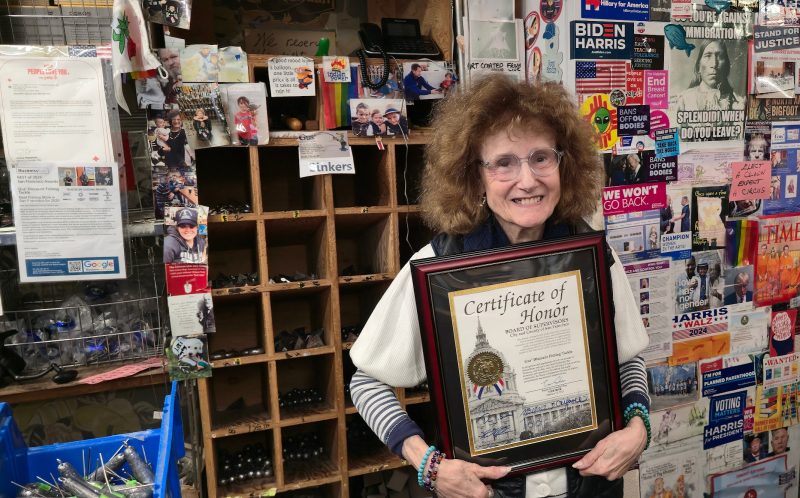
Inside, the walls are adorned with thousands of photos showing customers, their catches, and some of the moments they wanted to share. They include wedding photos of couples who stopped by the shop still dressed for the ceremony. The images are stapled up wherever there’s room, overlapping and fading, giving the place the feel of something that’s been added to over the years.
“Ninety percent of these photos were put up by my late husband,” Ernst-Scott said of Bill Scott, who died in 2019.
“When he passed away, there were about 1,500. They started small, and then everybody started sending pictures,” she said.
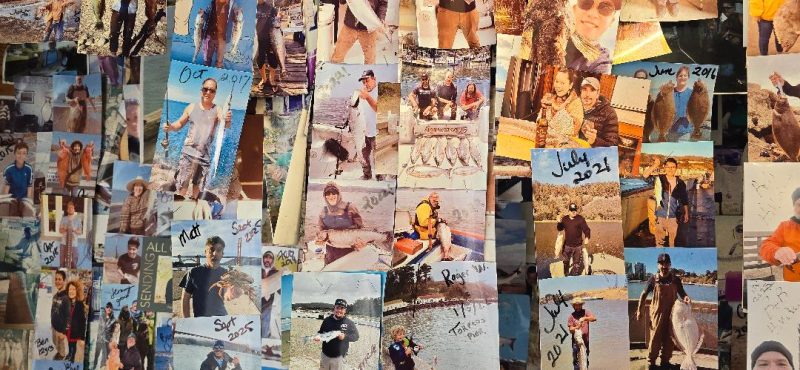
Customers still point out familiar faces on the walls or ask about pictures they recognize, and new photos continue to arrive. Ernst-Scott said the collection grew gradually over time, shaped by the people who passed through the shop and wanted to leave a photo behind.
After her husband died, Ernst-Scott said coming to the shop each day helped her get through a period of deep loss.
“The reason I’m here is it’s better than a psychiatrist,” she told the Richmond Review in a 2020 interview. “If I stayed at home, I don’t know what would’ve happened. Fifty years we were together. (Working here) just saved me.”

“They (the customers) become your family,” she said. “That’s pretty anomalous in a business setting. That doesn’t happen in a lot of places. People talk to you here in a way they don’t at a big box store.”
Ernst-Scott’s father, Gus Ernst, was a Holocaust survivor who escaped Austria in 1939 after fleeing a train bound for a concentration camp. He skied across the border into Switzerland while being shot at by the Gestapo. He later immigrated to San Francisco, eventually opening Gus’ Discount Tackle.
Ernst-Scott said her father originally opened the business on Clement Street as a kind of general store, buying out failed businesses and selling whatever inventory came with them. “Week by week it changed,” she said. Over time, the shop narrowed its focus, eventually becoming a full-time tackle store after moving to Balboa Street.
Lessons from her father
Her father’s experiences shaped how he treated people, particularly the importance he placed on kindness and dignity.
“He was an extremely ethical person,” she said. “You treat everybody kindly. That was everything with him.”
Ernst-Scott has continued that tradition, fostering an environment of inclusion for a diverse clientele.
“Everything and anything, every nationality, every language spoken. Murderers and their attorneys,” she said.

“I can have people in here from Ukraine and Russia at the same time, and they’re talking about fishing. They’re not at war,” she said. “At least for 15 minutes.”
But although diverse, her customers skew predominantly male.
“It’s pretty gender-specific, but every little girl who comes in here, I say, ‘Good, you’re going fishing,’” she said.
Ernst-Scott and her husband started working at the store when neither could find employment after getting their master’s degrees from San Francisco State University. Hers was in speech; his was in English.
“So, I said to my father, ‘Papa, you have to hire me,’” she said. “I thought, I’m going to work so hard you can’t throw that up in my face. I’m happy as hell I never left.”
Gus’ celebrated its 60th anniversary in October in grand fashion with a block party that featured live music, a circus act, and a raffle.
On the day of the celebration, the block was closed to traffic and filled with music, food, and neighbors stopping by throughout the afternoon.
“I was crying all day. It was so touching,” Ernst-Scott said. “A guy who usually buys bait from me came in wearing a suit and brought me flowers.”
The block party was organized by Jenna O’Connell, who owns the Laundromat, a gourmet pizza and bagel shop across the street from Gus’, which opened in 2022.
“One day we were just talking, and she showed me a congratulatory note she received from the city, and we decided right then and there that it should be celebrated,” O’Connell said.
“Gus’ is the original community center and continues to be that way. It fosters connection and relationships. I have never not had a pleasant time over at Gus’.”
District 1 Supervisor Connie Chan, who serves the Richmond District, attended the bash.
“They closed the block off, and five hundred people showed up,” Ernst-Scott said.
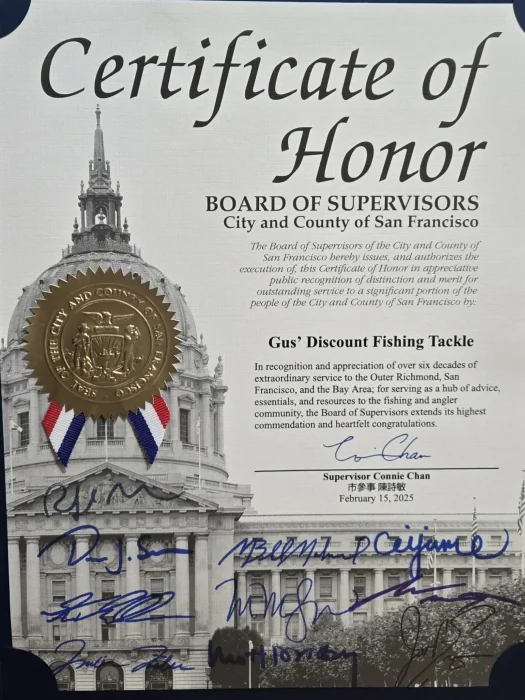
The shop also received a certificate from the city and the mayor’s office commemorating the anniversary.
“This is certifying we’ve been here 60 years,” she said, pointing at the framed certificate, “with all this nice junk in it.”
Ernst-Scott has thrived amid fierce competition from big box stores and online merchants by providing something her corporate rivals can’t.
Standing up to the big box stores
“Amazon will sell you a rod and reel, but they won’t tell you how to use it,” she said. “This is a very technical, step-by-step sport. If I didn’t know what I was talking about, I could be as friendly as possible, and it wouldn’t matter. You have to know what you’re talking about, or you’re failing.”
Ernst-Scott pushed back at the idea that her knowledge of fishing is “encyclopedic,” framing it instead as the result of decades behind the counter. “If I’ve been here as many decades as I have, and I didn’t know what I was talking about, that would be obvious to my very knowledgeable customer base,” she said.
“If I was in here BS-ing people, I would have failed a long time ago,” she said. “This is a very educated customer base.”
Much of Ernst-Scott’s day is spent answering questions from customers with varying levels of experience. Some are fishing for the first time, while others have been coming to Gus’ for decades.
For Ernst-Scott, that back-and-forth is intentional. She said people often arrive unsure of where to start, especially those new to fishing or crabbing, and she tries to slow things down rather than push a sale.
The goal, she said, isn’t just to sell gear, but to make sure customers leave knowing what they’re doing and feel comfortable coming back with questions or stories.
Her customer-first approach seems to be working.
“Out of the ten bait stores that used to be here (in the city), we’re the last one left,” Ernst-Scott said.
Gus’ attracted new customers during the pandemic, when the demand for outdoor activities grew. “We were a pandemic business, because it’s an outdoor activity,” Ernst-Scott said.
“People were going mad at home. On this street, it was us, the archery store, and the bicycle shop. Everything else was cordoned off.”
The COVID era brought a surge of customers, many of whom might not have otherwise discovered fishing, she said.
“It helped the community to have something to do,” she said. “People were losing their minds sitting at home.”
Ernst-Scott has two children, her daughter Ariana Estoque, an educator, and her son Jonathan Scott, a chef, as well as four grandchildren: a granddaughter, Ellery, and three grandsons, Ever, Calen, and Dyllan.
When she’s not at the shop, Ernst-Scott said she spends time with her family, often seeing her grandchildren, her daughter, and her son-in-law. Her son lives in Texas.
Retire? Not likely
Ernst-Scott said she has no plans to step aside anytime soon.
“People ask me all the time when I’m going to retire,” she said.
“I don’t see the point. As long as I have a semblance of my mind left and I can do the task at hand, I want to be here.”
After six decades, Ernst-Scott hopes the shop will be remembered as more than a place to buy bait.
“It’s more like a bar without the liquor,” she said. “They come here and tell you everything.”