

‘It was a chaotic time; we weren’t ready,’ wife says of husband’s surprise cancer diagnosis
Two years ago, Greg Myers and his wife, Lonnie Lebin, were leading a comfortable life in four-story Sunnyside District home. Myers, a former robotics engineer, was a runner, hiker, and enjoyed playing the piano. Lebin, a former kindergarten teacher, had begun taking classes in ceramics, exercised at the Stonestown YMCA and was a longtime performer with the Helen Miller Children’s Drama Service, entertaining children around the Bay Area
Today, they share a two-bedroom apartment in a five-story continuing care facility in the Excelsior District. They’re in one of its 113 assisted-living units. There are also 77 memory care suites should either of them ever need it. Lebin is still active, but Myers needs 24-hour care.
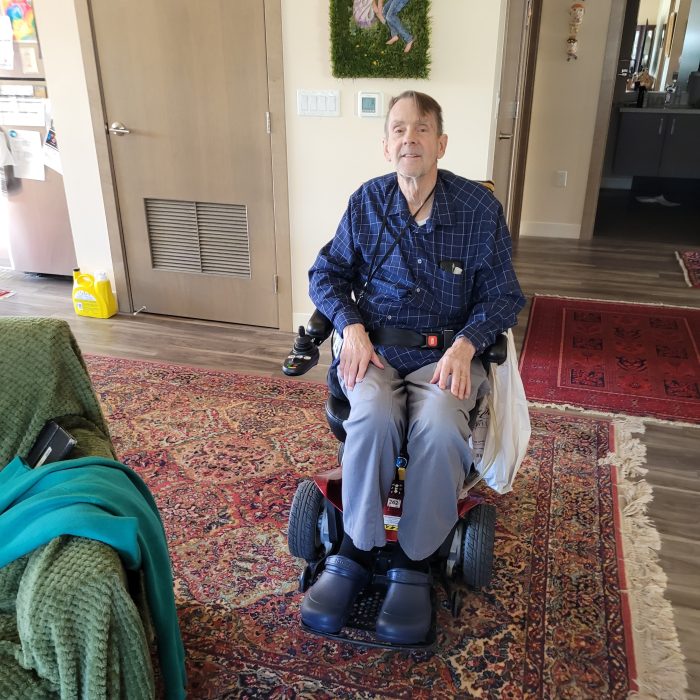
It all started after a seven-day hiking trip Myers took in Iceland. He began having pain all over. He lived with it for a while, with exercise and a stiff upper lip. As it got worse, he ended up in emergency care, where he was prescribed a pain killer. A second visit yielded a stronger pain killer.
Finally, in desperation, he made an appointment with his doctor, who told him, “Go straight to the hospital. I think you have multiple myeloma,” He ended up in surgery, the late-stage treatment for this blood cancer that weakens the bones.
Two and a half months later, after surgery and days filled with physical and occupational therapy, he was booted out of the California Pacific Medical Center-Davies. “It’s time to leave,” a social worker told him. “Medicare only pays for 100 days.”
Where to go? Paralyzed from the waist down, unable to get in and out of bed by himself, or to shower, dress, or use the bathroom by himself, he needed extraordinary care. If they wanted to stay in their home, multiple chairlifts would have to be installed, doors widened, a tub and shower modified, and 24-hour care hired. “I knew I didn’t want a person full time in the house,” Lebin said.
With no children or relatives to help with his care, their only option was to move into a facility that offered full-time care.
Overwhelmed
Myers preferred a sunnier locale, somewhere on the Peninsula, but Lebin wanted to remain near her friends. Although they found several suitable residences in San Mateo County, they agreed to limit their search to San Francisco. They wanted a two-bedroom apartment in a facility that took cats, had a gym, and offered a rich schedule of activities.
“It was a chaotic time,” said Lebin. She had her husband were both in their early 70s. “We weren’t ready.” They had never thought ahead or anticipated such a situation.
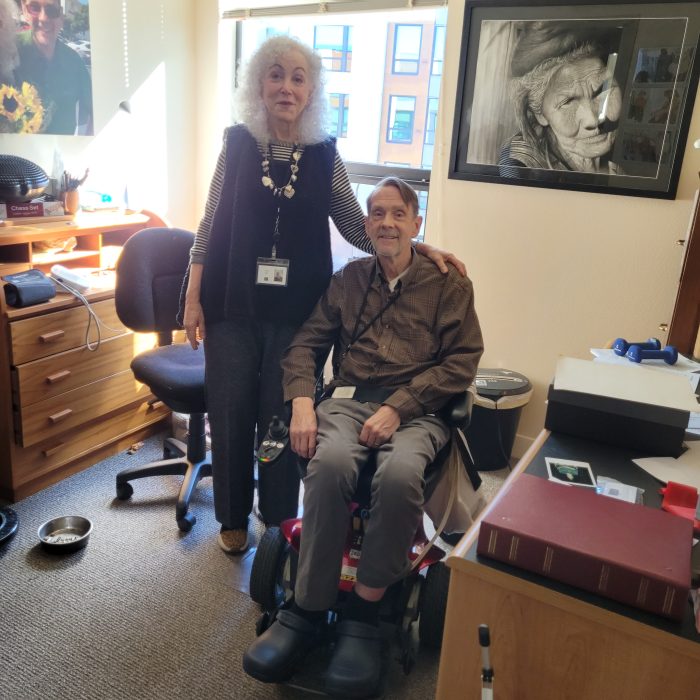
Myers shift from lead to dependent role changed their relationship. Myers had always managed the big issues in their relationship, Lebin said. “He was an MIT graduate; I’m lost without his brains. I was a princess. Now it was up to me.”
After recovering from hip replacement surgery, Lebin and her two sisters-in-law began a search. Myers, who under normal circumstances would have been in charge, was limited to background research on his computer.
They chose the Frank Residences and sold their house. It was expensive, with prices for a one-bedroom starting at $7,300 a month and going up to $15,000 and more for a larger unit. Their cost includes Lebin as a second occupant, meals, weekly housecleaning and whatever additional support Myers needs.

Myers adjusted fairly quickly to their new situation. Two months after they moved in, he began attending a newcomer’s group, was negotiating with Medicare for a motorized wheelchair, and was exploring the grounds in his rental wheelchair. A keyboard in their new apartment replaced his old piano.
A new dependence
He appreciated the friendliness of the other residents, though his new dependence was unsettling to both of them. Assistants wake him twice during the night to tend to his needs. “I’ve asked them to speak quietly,” Myers said. “It wakes Lonnie who is a light sleeper. She’s considering sleeping in the second bedroom.”
Myers remembers played a concert for Frank residents with his amateur piano group not that many years ago. “Everybody looked so old,” he recalled. “It’s strange living here. At 73, I’m one of the youngest. Now I’m one of them.”
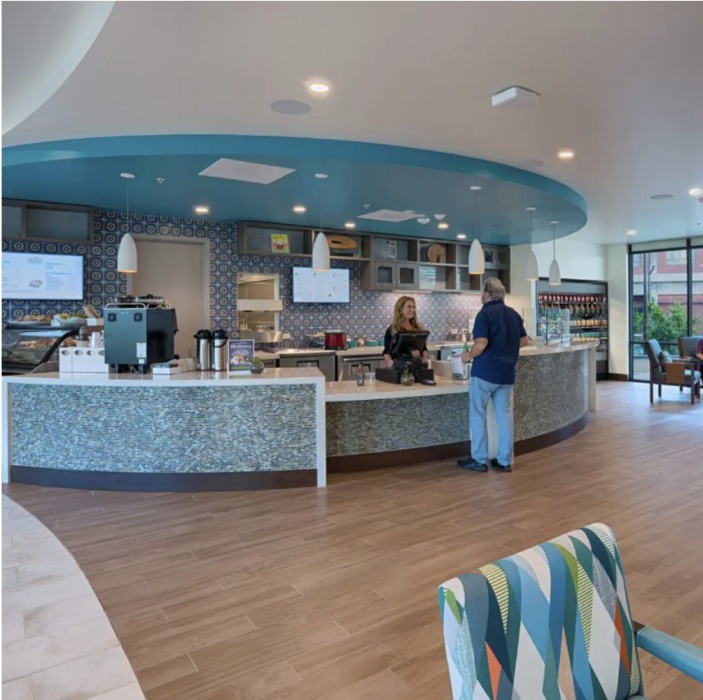
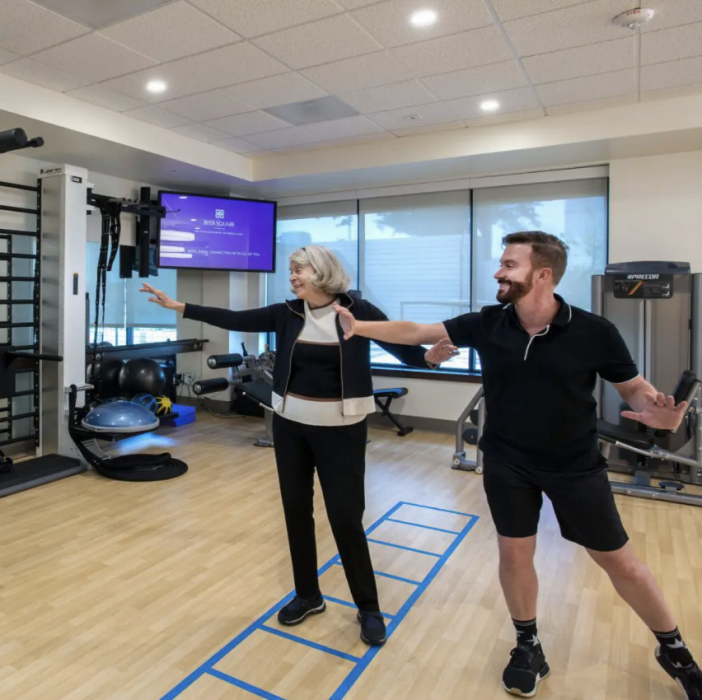
The Frank Residences, which sits on a 9-acre campus, has a host of amenities for residents. (Photo courtesy of frankresidences.org)
Lebin, found herself overwhelmed by multiple new responsibilities: sorting through their belongings for the move, furnishing their new apartment, finding space for her several art collections, and making new friends. “Not cooking, though, is a real advantage,” she admitted.
When a Frank theater group discovered she had been longtime performer with the childrens’ drama group, they sought her out, casting her as Queen Esther in their Purim festival. She joined a newly formed women’s group and has made other friends, too. Though she’s still taking classes at the Stonestown YMCA and meeting old friends for lunch, gradually the place she first saw as a “prison” was becoming home.
Though she still misses casual conversations with her neighbors and the comforts and freedom of following their own rather than the facility’s schedule, she said “under the circumstances,” the Frank Residences turned out to be their best option. But her words of wisdom: “Stay in your home as long as you can.”