


Car accident upends family counselor’s hard-won career and settlement in U.S.
Though her disabilities make it difficult for Alba Aguilera to attend marches like the political actions of her youth when the world seemed open to lofty change, she remains committed to the fight for freedom.
Sporting a “Save Palestine” bracelet, Aguilera , in her early 70s, carefully makes her way from her bed to the kitchen table in her South of Market studio. She has always had vision problems, but her mobility was nearly ended after she was hit by a car in 2014.
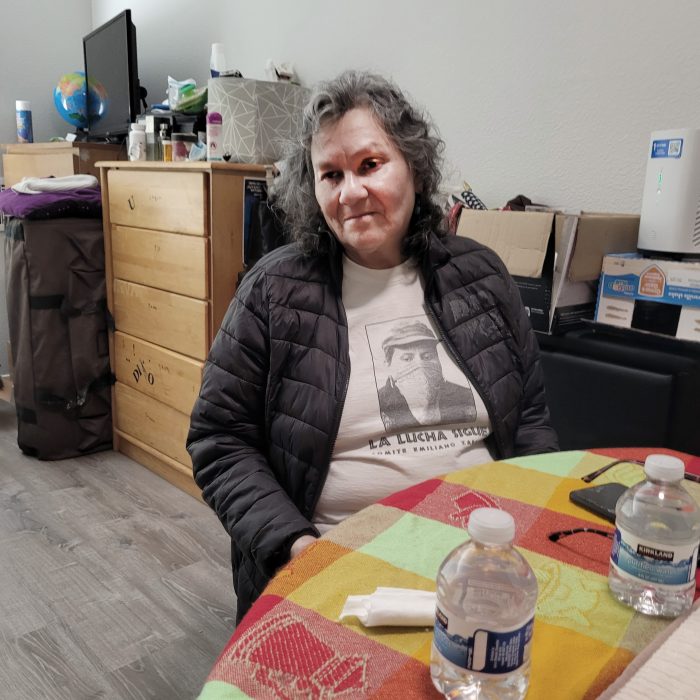
When she’s feeling well, she picks up her white cane and walks outside, often accompanied by a case manager from On Lok, a healthcare and senior service provider of which she is a member.
Living in the Soma Residences in the Mission district is a far cry from her last accommodations, a tiny room in the home of an elderly couple for whom she was a live-in caregiver. But it’s not the same as the high days when she and her daughter lived in a home in Pacifica, subletting rooms to help pay the rent.
Aguilera moved to the U.S. from her native Mexico in 1996. She came with her 14-year-old daughter and a bachelor’s degree in psychology from the University of Monterrey. Hoping to improve her chances at a professional job, she began taking psychology classes at City College of San Francisco. She earned money through caregiving jobs.
She eventually earned a master’s degree, found a job in family counseling, moved from an apartment in the city to a single-family home in Pacifica. Aguilera was working on a PhD In 2014 when she was badly injured in a car accident. Though her daughter, Iphigenia continued working, they were unable to afford the rent, forcing the family to return to San Francisco where they rented a variety of small apartments.
Employer abuse
When Iphigenia landed in jail for a driving while intoxicated conviction, Aguilera stepped in to care her six-year-old grandson, Itze, and went back to working as a caregiver.
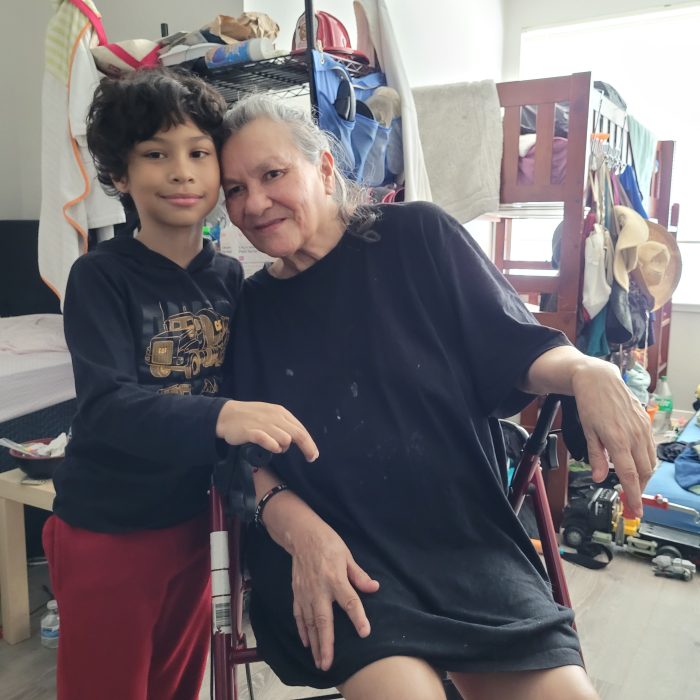
Her last job, for an elderly couple, included a tiny room and board for her and Itze. But it also came with abuse. At one point, her employers limited them to one small meal a day for the “two of us,” Aguilera said.
She called the city’s Adult Protective Services, which forwarded her complaint to On Lok. They found her and Itze the studio in the Soma Residences and a commitment from Catholic Charities to pay half the $1,400 a month rent. Aguilera’s Supplemental Security Income covers the rest.
“I like this place,” she said. “It’s close to Yerba Buena Park, Golden Gate Theatre, Market Street, and the Civic Center.” Her daughter, having completed her jail sentence, recently joined her mother and son in the roughly 500-square-foot studio.“It’s tight, but livable,” Aguilera said.
The Soma Residences, which advertises studios to one-bedrooms from $1,779 – $3,452, is not considered senior housing, like some city-subsidized units or assisted living facilities or board and care homes. In fact, most tenants are much younger.

But it’s one of the many places San Francisco advocacy agencies and nonprofits seek out to help seniors at risk. It would have taken much longer to get Aguilera an apartment in one of the city-subsidized senior housing units.
Born in Mexico, Aguilera worked for the farmworkers’ union in Chiapas after college. The ‘80s were turbulent years in Mexico as well as the U.S. “I became a feminist at 24 when I, like many other women, realized that even in that movement women “were still second-class citizens.” But she stayed because she enjoyed the work and needed the money.
When the union gave her the opportunity to work with farmworkers in the U.S., she seized the opportunity. Iphigenia joined her a month later, so she could undergo surgery for a wasting condition: No matter what she ate, she did not gain weight. Although she is still very thin, the surgery helped stabilize her.
Back to school
Aguilera was in her 30s at this time, and while the union work was exciting, she wanted a job where she could use her degree. Much to her disappointment, the only work she could find was as a house cleaner or caregiver. Not content with these jobs, she took psychology classes at City College after work to improve her professional vocabulary and familiarize herself with the concepts underlying her field in this country.
After graduating, though uncertain that she could handle the work, she applied to the master’s degree program in psychology at the now-defunct New College of San Francisco. The school arranged a generous financial aid package, which, with part-time janitorial work, enabled Aguilera to complete the coursework for a degree.
“The program was difficult,” she said. “My English was not good; I didn’t know the vocabulary. Fortunately, we had entered the digital age, and I could look words up online. And my professors were very the helpful.”
With her master’s degree, she landed a job as a family counseling intern with the Bay Area Community Resources in their San Rafael office. “We helped families in crisis understand their problems and develop new skills.” On Fridays, she and her daughter, who often accompanied her, took families to parks, movies and restaurants. “We wanted to demonstrate that there was more to life than drugs and alcohol.”
Ever the student, she later enrolled in an online Ph.D. program at Northern Arizona University, but her lack of writing skills, and physical injuries prevented her from finishing.
The good years
Those were good years, Aguilera recalled, when the income from her San Rafael job, and her now-adult daughter’s jobs in customer services enabled them to afford the Pacifica house. The car accident upended their lives. Several of her vertebrae were injured – “I almost broke my neck” – her occipital nerve was damaged, causing neck and head pain. It left her partially bedridden and almost totally blind. It also qualified her for SSI, which she has been on ever since.
Aguilera has been hospitalized in the last few months for what started out as a kidney infection and evolved into pneumonia and sepsis. Her body aches all over, she gets sick often, has trouble with her vision and reads with a magnifying glass.
Soma Residences, unlike many city-subsidized senior housing units, assisted living facilities or board and care homes, provide no support aside from security. But, because her low income qualifies her for Medi-Cal, Aguilera is able get help with non-medical things like cleaning, laundry, cooking, shopping, and dressing and toileting through the city’s In-Home Supportive services.
Her On Lok case manager helped her furnish her apartment, drives her to appointments, makes sure all her paperwork is in order and is trying to convince IHSS to increase Aguilera’s hours of in-home help.
A visiting nurse comes once a week, but Aguilera, who is still recovering from her hospitalizations, said “it’s not enough. I need fulltime help. I have a high heart rate and lack of vision. I’m vulnerable and in pain, I have trouble going to the bathroom. Each hour is more painful than the one before. I’m depressed and I worry. What if I fall during the night, who will pick me up? My daughter can’t, she’s not strong enough.”
A book in mind
The political situation, which she’s eager to keep on top of, only adds to her worries. She said she got “really scared when the U.S. sent bombs to Israel.” She wants to know “what’s happening with Russia and Ukraine; the neo-Nazis, what’s going on with Trump.”
Aguilera wants to write a book about her experiences as a socialist feminist. She knows that others have covered that ground, but they addressed “the outside part of being a socialist militant feminist, not the inside, feeling part.”
She’s been reading her story onto the phone but needs the inspiration that comes from having time to think, and the music that calms her. But with three people in a small space, the other two often watching TV, it’s difficult.
“I would do more,” she said wistfully, “if it were quieter at home.”



Melanie Grossma
Amazinng cstory of courage and and determination. Also,I recommend that she join a women's writing group.