



During the day, you’ll find Thomas Drohan in court or at his law office on Mission Street. But on many Tuesday nights, he’s playing the standup bass at the Page Bar, a neighborhood watering hole on the edge of the Upper Haight.
Drohan, 68, an attorney for more than three decades, is the director of litigation for Legal Assistance to the Elderly, a nonprofit that last year represented more than 1,900 seniors and disabled persons at no cost. Opened in 1979, it was put on San Francisco’s Legacy Business Registry in 1920.
Many were facing eviction, an all-too-common issue for low- and even middle-income San Franciscans as rents continue to soar. Last year, landlords attempted to evict 3,500 renters, an 18 percent increase over the previous year, and a 25 percent rise over 2024, according to the Eviction Defense Collaborative.

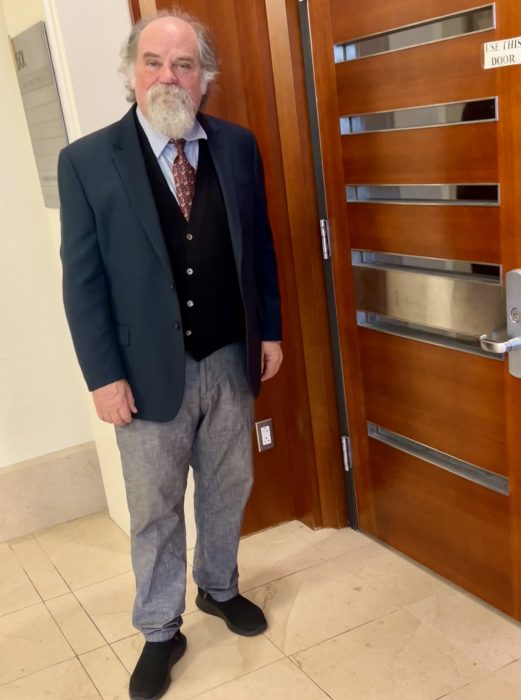
“The unfairness of the system outrages me,” said Drohan, who has specialized in landlord-tenant law for most of his legal career. He calls the work “compelling; it has a kind of an emergency room vibe to it.”
When he’s in court, Drohan wears a modest version of the lawyer’s usual uniform of jacket, tie, and vest. But with his heavy white goatee and mustache, large hands, Rob Roy shirt, and ballcap, he might be mistaken, when he’s off work and knocking back a beer between sets at the Page Bar, for a retired construction worker.
In fact, Drohan, a one-time high school dropout, worked as a plumber and a construction worker. “I was never very good at attendance,” he comments wryly, noting that he was expelled from both public and private high schools. Eventually, he decided the trades weren’t for him and took night classes, ultimately earning a GED and admittance to Golden Gate University. A law degree from Boston University School of Law followed.
Drohan interned at Legal Assistance to the Elderly (LAE) and became a staff attorney for the group more than 26 years ago.
At the time, LAE was small and underfunded. When he first worked there, it paid the lowest salaries of any legal services group. “At one point, music gigs were a significant part of my income, maybe 25 percent,” Drohan said.
After trying his hand at bankruptcy cases, Drohan decided to specialize in housing issues, and for years he was the only attorney on the staff specializing in eviction defense. Now there are eight, part of a staff of more than 30 lawyers, paralegals, and support staff.
As LAE has grown, it has offered legal aid in a wide variety of areas, including elder abuse protection, benefits advocacy, consumer debt defense, foreclosure prevention, and end-of-life planning.
But eviction defense still accounts for much of its work, and having legal representation greatly increases the odds that a tenant will not be evicted. Approximately 92 percent of the tenants LAE has represented remain housed, though some have reached a settlement that pays them to move elsewhere, according to Drohan. “Avoiding homelessness is the priority,” he said.
The ‘cruelest’ landlord
“Many landlords are problem solvers, and we can work with them to resolve a situation without even going to court.” But some have no intention of reaching an accommodation, he said.
Sheila Hembury and Leonard Johnson had been living in a two-room apartment in the Mission for about a dozen years when the building was sold. The new owner, Anne Kihagi, soon began to pressure tenants to move, but Hembury and Johnson – both seniors — had no intention of abandoning their rent-controlled home.


As recounted in court records and published reports, water and electricity were intermittently cut off, and needed repairs were left undone. The door to the communal backyard was padlocked, and garden furniture was thrown out.
One afternoon, Johnson, a retired iron worker, was slicing vegetables in his kitchen when he heard his front door open. Three people, including Kihagi, a building inspector, and a workman, had entered without permission. Surprised and angered and still holding a kitchen knife, Johnson, then 74, stood at the foot of the long hall and told them to leave.
Two months later, the couple was stunned to receive an eviction notice, claiming that Johnson had approached Kihagi, brandishing a knife and threatening her. Hembury and Johnson decided to get legal help. “I hate bullies,” Hembury said.
Drohan represented them and the eviction was thrown out. “It took a year to go to court, and Tom stuck with us. He’s really smart and warm,” Hembury said.
Losing the case turned out to be the least of Kihagi’s problems.
She became known as the city’s “cruelest landlord” and was sued and fined by the city multiple times. Saying that “ordinary remedies are inadequate and ineffective” in dealing with Kihagi, a Superior Court judge “took the extreme step of wresting away her eight known remaining residential properties and placing them under the control of a court-appointed receiver,” Mission Local reported,
House calls
Lawyers aren’t known for making house calls. But Drohan often does, as Ray Wenzel discovered after suffering years of conflict with his landlords.
Wenzel, now 72, had been living in a two-bedroom, Edwardian-style flat in the Upper Haight since 2009. Five years later, the building was sold, and he soon suffered what he believed was a campaign of harassment aimed at convincing him to move.


A visit to the city’s Rent Board won him a small settlement, but conflict with the owners continued unabated for years, culminating in an eviction notice last year. (The owners claimed Wenzel had damaged the property.)
“I couldn’t afford a legal defense, and I didn’t even know what forms to file in response,” said Wenzel, a worker/owner at Rainbow Grocery. “I would have given up and left.” Alerted to LAE’s services, he was happily surprised when Drohan and a colleague visited his home.
Drohan was able to quash the eviction and negotiate a court-supervised settlement that kept Wenzel in his home. Wenzel, like Drohan, is a dedicated amateur musician, and the two hit it off. “Tom is very energetic and straightforward. I would love to have him as a friend,” said Wenzel.
Fighting evictions is expensive. LAE and other legal defense groups are paid $6,300 per case from a fund that’s part of the city’s Tenant Right to Counsel program. The program was authorized in 2018 when San Francisco voters passed Proposition F. The real cost to represent a tenant averages $7,200, according to the Tenants Right to Counsel Program.
Spending $6,300 to avoid an eviction and homelessness yields an excellent return on investment for the city: Housing someone in a shelter and providing medical and psychiatric care, plus other expenses costs the city approximately $62,000 a year, according to the Right to Counsel Program.
Drohan was born in New York City – his father was from New York, his mother from Berkeley – but the family moved West, and he was raised in Tiburon. His father was an executive who became the CEO of Foremost-McKesson (now McKesson); his mother ran the household.
After dropping out of high school, besides working in plumbing and construction, Drohan was an aide and teacher at a sheltered workshop for the disabled in the North Bay.


One of his roommates was in a band and when a guitarist dropped out, Drohan taught himself to play the bass guitar and filled in. “It was an absolute blast. I played with those guys for years,” he said. Later a friend of his father passed away, and his widow gave Drohan her late husband’s standup bass, now his instrument of choice.


Over the years, he’s collaborated on several CDs with different bands, one featuring swing, another featuring “Old Time,” a more melodic predecessor of Bluegrass. He keeps a stack of them in his desk at work. “Playing in a band requires a totally different mindset than work, and I love the collaborative aspect.”
The standup bass is unwieldy, so he puts it on a cart and walks from the home in the Lower Haight he shares with his wife, Gayle, and their dog, Buckle, to the Page Bar on Tuesdays.
Drohan inherited land and a home in the Gold Country, where he’s planted a small vineyard and makes wine.
Retirement, though, isn’t on the horizon. He’s energized by the passion young lawyers, many burdened by debt, bring to their work. At an age when many of his peers have stepped away, Drohan is still at it, still arguing, still fighting, still carrying that sense of outrage with him into court.
“We’re still pushing the rock uphill,” he said.