

Nonprofit director is happy to bug you, whether you’re 2 or 92, about saving the wild
If you grow up in Los Angeles, where do you find the wild? Norm Gershenz is not talking ”bright lights, big city” wild, he’s talking “lions and tigers and bears” wild.
Although he had a typical urbanized childhood, Gershenz says he couldn’t wait to leave home at 17 for San Francisco State University, “where it turned out I loved biology.”
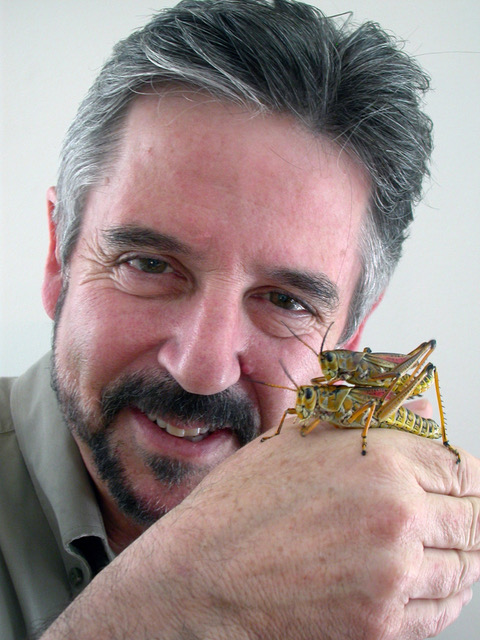
From welcoming the first pandas and koalas to San Francisco Zoo to touring the world as an expert naturalist, to co-founding SaveNature.Org with his wife, Dr. Leslie Saul-Gershenz, a University of California-Davis-trained entomologist, Gershenz, 73, has dedicated his life to saving the wild.
“I thought I was going to be a children’s writer, but I started taking all the courses on field biology, birds, mammals, insects, and well, the rest as they say is history–natural history.”
Gershenz is also a gourmet insect chef, lecturer in biology, expert birder, and “can spot a beetle at 50 mph.” Even in the face of seemingly relentless dismal news about the health of our planet, he is here to tell us – and inspire us – that we can make a difference.
Somewhere around 1988, Gershenz said he had an idea that many people would be willing to donate a quarter for wildlife conservation. He talked his friend at the city parking authority at the time into donating the department’s retired, mechanical parking meters. Then he had a design company retrofit them with a colorful hummingbird and jaguar cutout that pops up in the window when a quarter is deposited, along with a message saying 90 square feet of rainforest has just been saved.
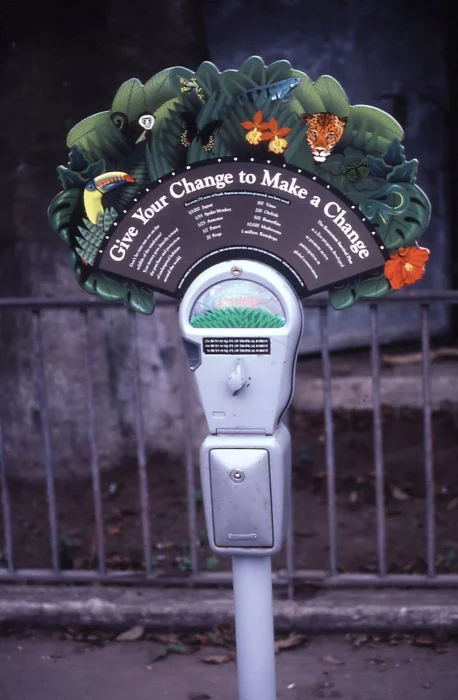
When a prototype was installed at the San Francisco Zoo, it raised $1,200 in the first week. The idea spread to zoos, botanical gardens, museums and nature centers around the U.S. and were primarily installed in the late 1980s and 1990s, contributing to over $1 million in donations for rainforest conservation by February 1999. Hundreds are still in use, he said.
These “Conservation Parking Meters” were launched as part of his and his wife’s Ecosystem Survival Plan (later to become the nonprofit SaveNature.org) to raise funds for conservation. Gershenz developed the idea after visiting zoos across the country and discovering that only the wealthiest were engaged in any conservation efforts on site. His vision was to empower zoos nationwide to actively involve visitors in the conservation of nature and all its biodiversity.
They also established the first Adopt-An-Acre and Adopt-A-Reef habitat protection programs in the United States to protect endangered rainforests and ecosystems in Central/South America, Borneo, Namibia, and the islands of Palau. Donations directly fund the acquisition and preservation of these habitats. Through the efforts of its zoological partner organizations, including schools nationwide, the nonprofit has reached over 80 million people and raised more than $5 million for the conservation of endangered habitats worldwide.
‘Habitat forming’
As CEO and director of SaveNature’s Insect Discovery Lab (IDL), Gershenz and his staff at SaveNature’s 699 Mississippi St. office have shared the love of nature with more than half a million young students throughout the Bay Area, helping ignite their desires to become active stewards of the earth.
“Handling a giant African millipede, Malaysian thorny walking stick, or Madagascar hissing cockroach will change your life forever,” he said. “Put a grasshopper sporting all the colors of crayons in someone’s hand and there’s not a person from two to 92 years old that isn’t awed, and that’s where the questions start – everyone’s a born naturalist.”
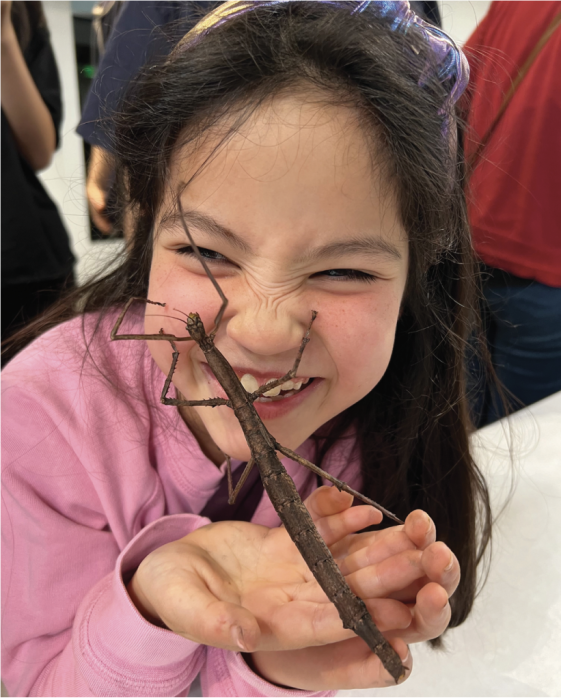
The nonprofit’s catchy theme: “Saving Nature Is Habitat Forming.”
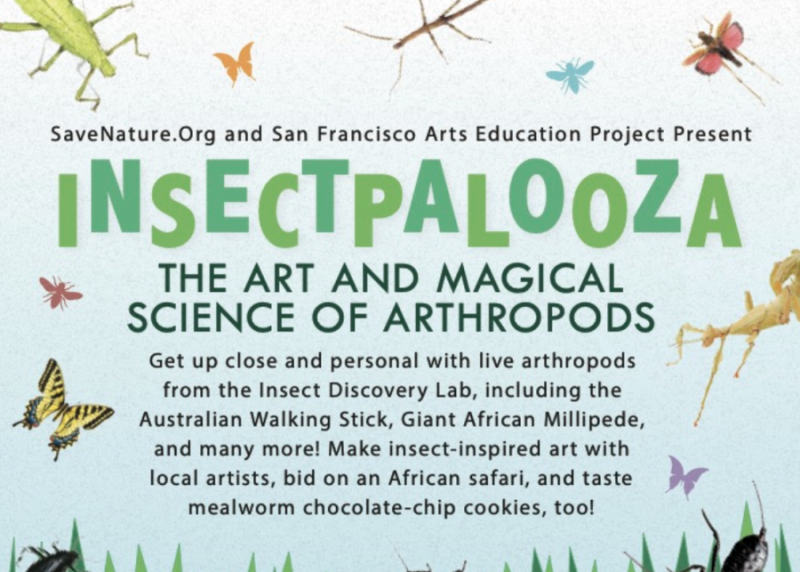
Gershenz said SaveNature.org draws a direct line between insect education and conservation efforts. Upcoming events include BUGOLOGY at The Dogpatch Hub on Saturday, April 25 from 11 a.m. to 12:30 p.m., and its sixth annual InsectPalooza at Minnesota Street Project on Sunday, June 7, from noon to 3 p.m. Both are free.
When Gershenz was a boy, he said the only time he thought about insects was when one of his parents said, “Oh my God, there’s a BIG bug. Where’s the newspaper?
“In Los Angeles people hate insects. My family never went outside, rarely went on vacation,” he said. “Boy Scouts helped me appreciate nature.”
Yet his mother helped him nurture a love for all animals.
“We always had two dogs, two cats, and then there was Beverly Park and Ponyland: the “Kiddieland” that inspired Walt Disney. They had a bunch of extra guinea pigs, and we came home from school one day and the backyard was full of guinea pigs,” he said. “That was my mother’s approach to life. She loved animals, and she loved kids, thank God.”
Gershenz remembers that early on, his father was an itinerant hazzan (cantor) serving in Los Angeles, Santa Monica, Downey, and Glendale. He said his father preferred listening to opera more than leading songful prayers, and liked to sing, and by the time Gershenz was in elementary school, his father owned a rare record store.
“Everybody loved my dad. My father was a big character, and he became an actor at 80 years old, an interesting fifth act,” Gershenz said, noting that he appeared in the TV sitcom “Will & Grace” among other shows, and the movie “The Hangover.” “He couldn’t get enough culture, played opera records and sang constantly around the house.”
Panda keeper
“But when it came to my mom and the three of us kids – I was the middle one – my father was “busy selling records, making cassette tapes for the movie industry, and filling our garage with sheet music … day and night.” But he did buy Gershenz a clarinet, which he learned to play in elementary school. He gave it up to focus on baseball in junior high and by high school realized, “I was interested in science, I was interested books, and I was interested in writing.”
Gershenz entered San Francisco State University in 1970, the same year Earth Day was inaugurated.
“When I started taking biology field classes, particularly my first natural history of vertebrates with Dr. James Mackey – a subject I didn’t know existed – little did I know how much he would influence my life. Dr Mackey had all the answers, yet his style, which is the style I inherited, is to ask questions. With him, I became the discoverer, the scientist. It was empowering and I’ve never forgotten that.”
The San Francisco Zoological Society, the main fundraising source for the San Francisco Zoo, hired Gershenz right out of college. It was the mid-1970s and the zoo was transitioning from small sterile enclosures to open naturalistic habitats. “The first thing they asked me was, ‘Can you write?’ and when I said yes, I was hired.” Gershenz wrote children’s shows and scripts for tours around the zoo and soon was tapped to be the first to present shows like Secrets of Survival, Animal Encounters, and bird shows.
Working with animals at the city’s zoo requires passing a civil service exam, specifically for positions like Animal Care Attendant or specialized zookeeper roles. Gershenz passed both these exams and for more than 18 years served as an educator, member of the animal care staff, fundraiser, and researcher.
Moonlighting
That wasn’t all he did. Like his father, he was an opera fan and liked to sing. So he supplemented his income moonlighting as a backstage dresser at the San Francisco Opera and for Eastern Onion singing telegrams. His last was job was courtesy of the San Francisco Giants, who hired him to celebrate 100 years of umpiring. But when he stepped onto the field in his red suit with microphone and mechanical monkey in hand, he said, four umpires approached and told him to get off. The singing telegram was indeed a surprise. When the umps walked over and stood by 3rd base the crowd booed, he said. He thought it was for him. Still, he turned to face the fans behind home plate and belted out what he called one of his finest performances – to wide applause.
At the zoo, the highlight of his career, he said, was being the keeper of the pandas during their 1984 visit to the United States as part of the Olympics — a rare, once-in-a-lifetime experience. One of his favorite memories is talking pandas for a whole hour with KGO radio host Ron Owens. Gershenz bet Owens a steak dinner that not only could they talk pandas for an hour, but that he – and his audience–would be fascinated. Gauging by the number of call-ins to the show, Owens lost the bet.
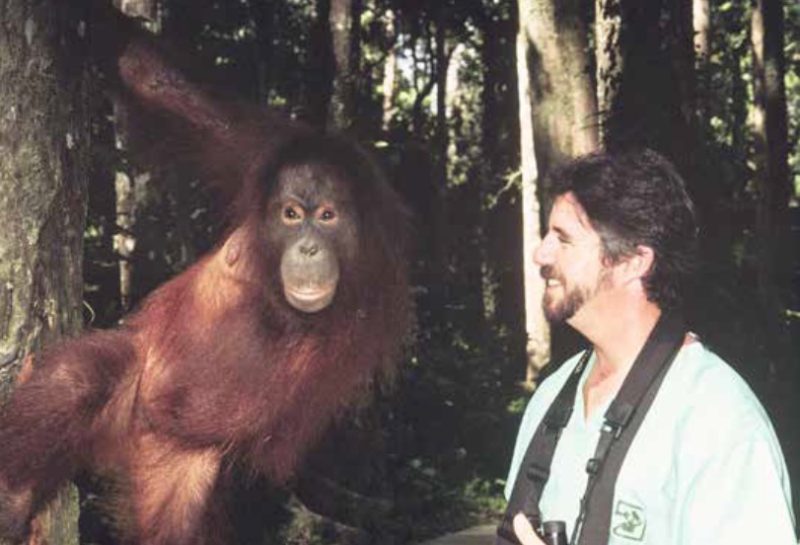
In addition to pandas, he handled boas and bobcats, elephants, snow leopards, koalas, hippos and hornbills. During his time with the zoo, he also did field biology and naturalist work in Borneo, Malaysia, India, Nepal, Costa Rica and Namibia. He tracked black rhinos in Zimbabwe, chased orangutans in Borneo, stalked the elusive platypus in Australia, and led tours with his wife, a conservation researcher at the Zoo specializing in ground-nesting bees and parasite-host interactions.
“I didn’t start out interested in insects,” Geshenz said. “I thought I was going to be an ornithologist; I loved birds. Then I met Leslie at the zoo, and she changed my life. “
Moth ‘parents’
While the intensity of their immersion in their respective fields precluded children, they do have namesakes: Ethmia lesliesaulae and Ethmia normgershenzi are newly discovered species of moths in the rainforests of Costa Rica. Described in a 2014 ZooKeys monograph, the moths belong to the familyDepressariidae and now they’re part of the Gershenz family, too.
One of the most poignant projects for Gershenz, however, ended before it had a chance to take off.
It took him nearly a year to convince UCSF Benioff Children’s Hospital to allow him to bring live insects from the Insect Discovery Lab into the Child Life Center as a form of nature therapy for children facing serious or life-threatening medical conditions. He called his program Smiles of Hope.
He might see from one to six children show up for his presentation. One day, it was just Owen, whose mother told Gershenz his three weeks had been incredibly difficult. She could not remember the last time he had smiled.
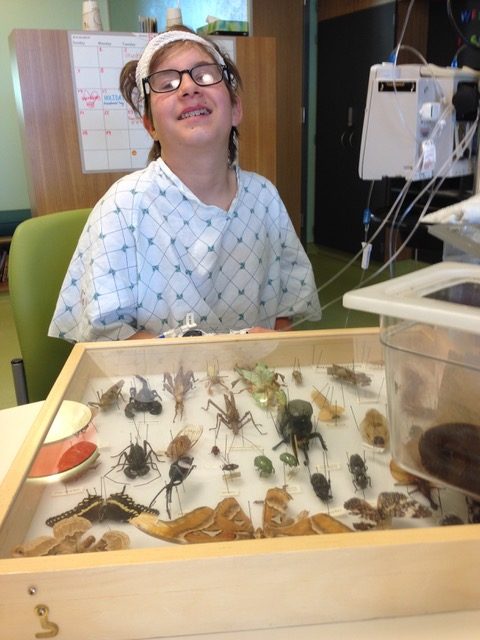
“One by one, I introduced him to giant African millipedes, Australian walking sticks, darkling beetles, along with stories from my years exploring tropical rainforests,” Gershenz said. “Owen never took his eyes off me.” After 45 minutes, when he showed Owen his box of pinned rainforest insects gathered over the past 25 years and asked if he could take his picture, the boy smiled.
Sadly, said Gershenz, shortly thereafter an executive at the hospital said bringing live animals into the hospital was not possible.
Through habitat destruction, climate change and pesticides use, insect numbers are down, species are being lost, and plant pollination is in jeopardy, he concedes, but said, “I’d rather tell a child: Look, 25 cents can save 360 square feet.”
“There are more insects than any other type of animal on earth, The SaveNature.org website explains: “This is true no matter how you measure their numbers – in terms of individuals or species. One scientist calculated that for every person on earth, there are about 200 million insects alive at any one time. More than 75 percent of all the named animal species are insects and there are millions of insect species yet to be discovered, named and classified!”
When asked how long he expects to helm SaveNature.org, Gershenz said retirement isn’t in his plans. “I have a small board, and they’ve asked me for my exit strategy the last few years in a row; I’ve told them it could be 10, it could be 20. I want to stay here so I can keep doing good work.”
He said he has slowed down a bit, spends a little more time with his other passions: art and museums, and he can be found with his dog Sophie at Jackson Park and other green spaces in Dogpatch and Potrero Hill near his office, and Bernal Hill near his home in Bernal.
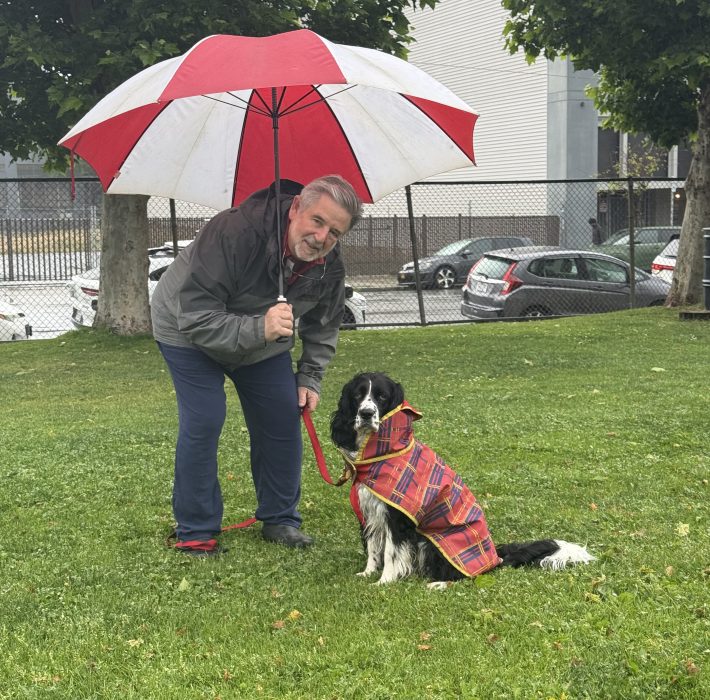
“It’s not just about the bugs.” Gershenz said.
He’s energized by the passionate young naturalists on his team inspiring the next generation of conservationists. “For me, it’s a small step to put nature into someone’s hand and say, ‘Look, we have a chance to do something positive.’ You have to offer someone a way to make a difference.”