

‘So hard, all the losses and pain:’ Personal and world tragedies led daughter of Holocaust survivors to life of helping others help others
Juliet Rothman was living in Annapolis, Maryland, in 1992 when her 21-year-old son Daniel attempted a double flip from a diving board into a swimming pool and broke his neck when he hit the water. Both arms and legs were paralyzed. Not only could he no longer walk but couldn’t feed himself or talk.
A little more than two months later, after deciding he no longer wanted to live, his life support was turned off.
When the dean at Catholic University in Washington D.C., where Rothman was teaching social work at the time, suggested she become a professor of death and dying, she was taken aback. I said, ‘How could you ask me (to teach a class like that)? That’s so crazy when I’ve just gone through this.
“And the dean said, ‘It will be good for you – and your students.’ And she was right.’ “
After moving to San Francisco in 2000, Rothman, now 83, taught courses in social work and death and bereavement at the University of California at Berkeley for 17 years before retiring.
The work “really got me thinking about disability,” she said, “and I made an interior kind of personal commitment to helping people with disabilities in any way that I could – so that people didn’t end up having to make the kind of choices my son made, if possible.”
While at Berkeley, she taught doctors how disabled patients adapt to life and wrote a textbook, “Social Work Practice Across Disability,” which is in its fourth edition and has been translated into Chinese.
Tikkun Olam
Her introduction to would-be social workers on the first day of each new class included a brief note about her son. “I just said I was dedicating my death and bereavement teaching to the memory of my son, who had a swimming pool accident, and that I was sure that everyone in the class could think of a loved one that they had lost.
“I acknowledged that we would all be thinking about loss a lot during this class, including our own, and that we’d take time for reading and discussions to deepen our understanding.”
Family history added further motivation for her work. “Tikkun Olam, the Jewish principle of healing the world, is very important to me,” Rothman said.
To survive the Holocaust, her Jewish Italian parents fled to Portugal from Italy in 1940, when its ruler, Benito Mussolini, joined Nazi Germany and other Axis Powers to declare war on France and Great Britain.
Two years later, they got visas to come to America. Rothman was born in the “enemy alien” section of Chicago’s South Side, a segregated area where Germans and Italians were forced to live during WWII.
Along with Japanese in the United States at the time, thousands of Germans, Italians, and some Romanians, Hungarians, and Bulgarians were sent to internment camps or put under restricted movement under the Alien Enemies Act.
Rothman’s earliest memories, “engraved deep and permanently within me,” she said, were stories of the horrors of the Holocaust.
The family moved back to Italy after the war, in 1946. For years, when she was just a child, she remembers, “refugees would appear in my parents’ living room and sob and tell their stories and everyone would be in so much pain,” she said. “I remember them today just as though I was still there.”
“So hard – all the losses and all the pain. Then we moved back to New York and I learned English.”
Mobility barriers
Today, the Russian Hill resident is focused on making life more bearable for seniors and people with disabilities trying to maneuver in a busy, crowded city. She is spearheading an effort called Accessible Community Teams, or ACT, designed to uncover situations that make life difficult for people with physical limitations in the hope of correcting them.
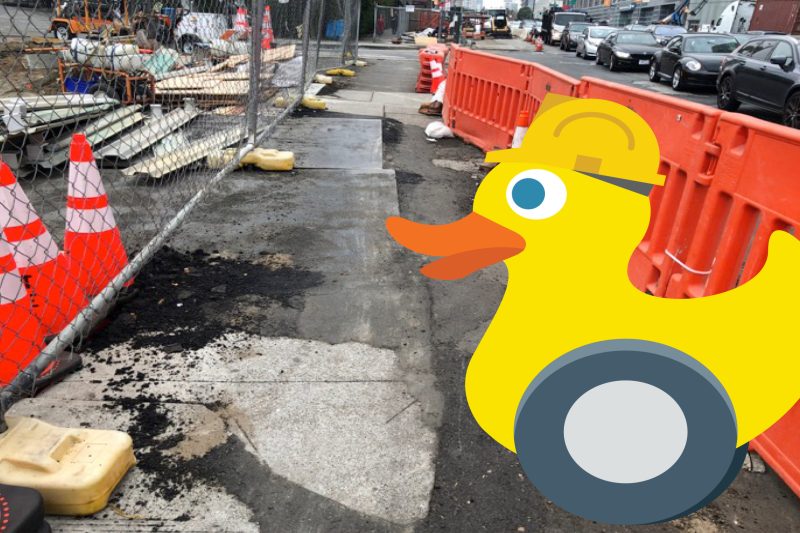
Sponsored by the Community Living Campaign, ACT recently received a $20,000 grant from AARP to send teams into about a dozen San Francisco neighborhoods. It’s a separate program from CLC’s SF Sidewalk Search Party, in which community members since 2019 have been meeting to photograph sidewalks obstructed by construction or undermined by tree roots, urging private and city crews to create temporary pathways or make repairs.
ACT volunteers will be looking for uneven sidewalks, lack of sidewalk ramps at intersections, and pointing out more intersections where devices called Accessible Pedestrian Signals that help people with visual difficulties safely cross a street can be installed. They are currently at 520 – about 40 percent – of San Francisco intersections.
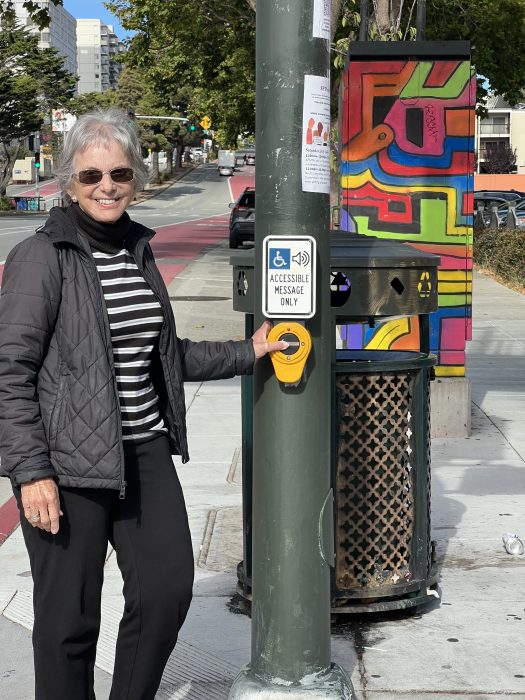
Beneath signs that say “Accessible Message Only” are buttons that when pushed will let a pedestrian know when the intersection light has turned green and it’s safe to cross. An audio message says “Wait” or “Cross” followed by a clicking noise that lasts about five seconds.
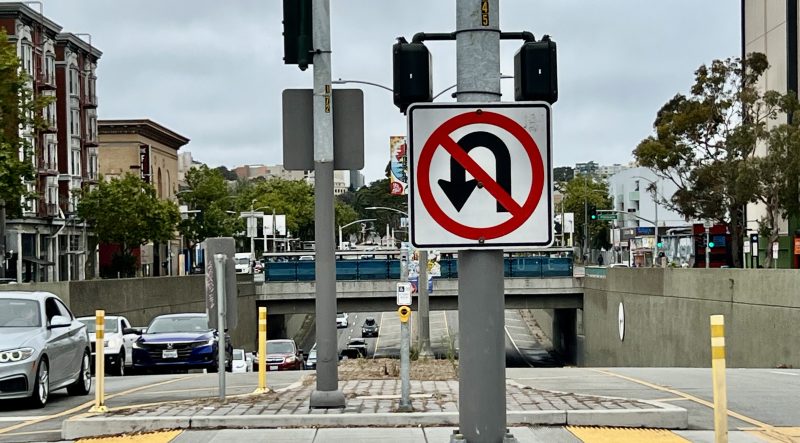
Some of these accessible buttons are also on the medians of wide streets. If someone makes it that far but is worried about having enough time to complete the cross, they can press the button to be notified when it’s safe to go.
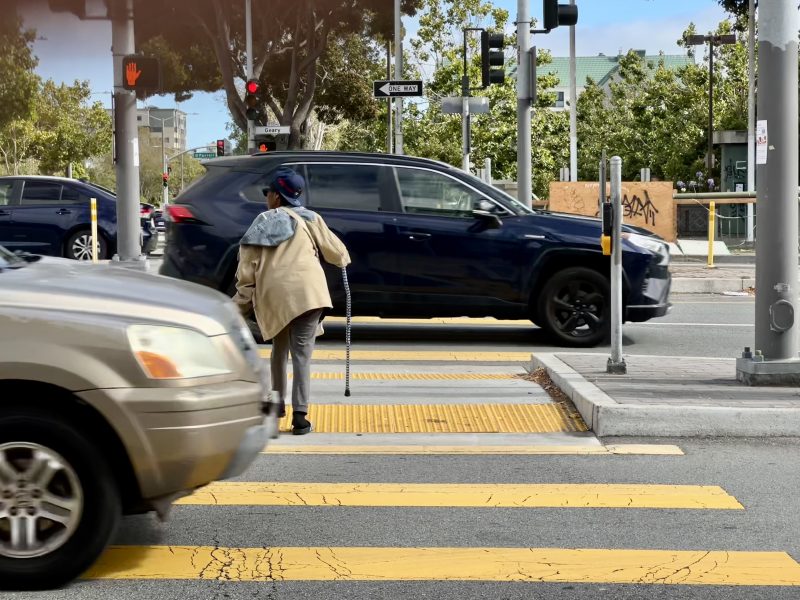
The teams will also be looking for indoor hazards, such as particularly heavy doors in commercial and public places, such as restaurants or stores that don’t have adequate access for wheelchairs. They’ll also search steps to buildings with no ramps, missing signage, obstructive tree limbs, high counters at checkouts and inaccessible bathrooms or dressing rooms.
Reducing barriers to getting around can have a positive impact on a community, especially older residents not to mention the volunteers themselves, Rothman said.
“It reduces isolation, it gives you a purpose, a reason to get together, a feeling of responsibility, all those really positive, social worky things that you can think about when you think about neighborhood and neighborhood relationships.”
Neighborhood focus
Rather than any grand solutions, the ACT team will be spotlighting simple-to-remedy problems that can be uncovered by anyone at any time. “It can be (when) people (are) walking to get a newspaper. Or going to the coffee shop and meeting a friend. (This project) can be whatever the neighborhood wants it to be. So, there’s a lot of flexibility.”
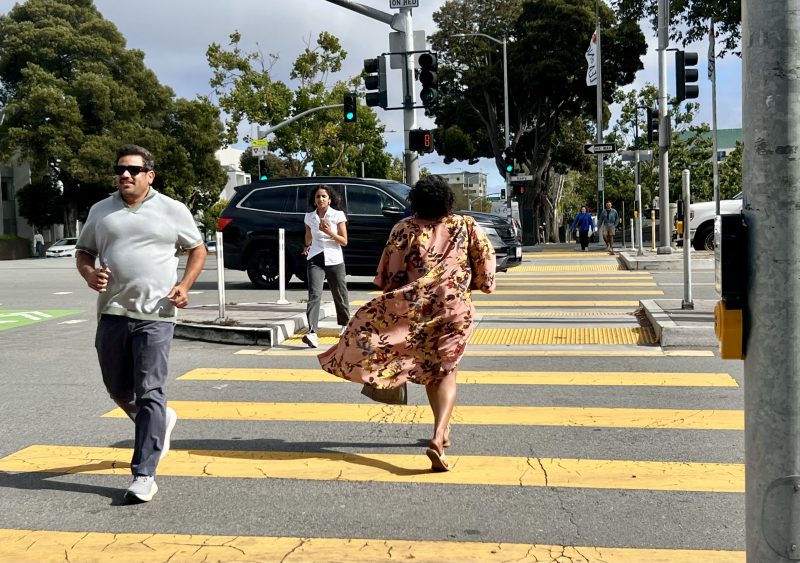
Rothman has already produced a 20-page booklet to be handed out to people in the neighborhoods listing what type of situations to look out for. Her next goal is to train others to help with the project.
Rothman has been married to her husband, Leonard, a now-retired gynecologist, for 63 years. They met at orientation at Tufts University when she was a 16-year-old freshman. The two of them eloped to Washington D.C. during their first year of post-graduate work without telling their parents. He was in Boston, and she was at the University of Pennsylvania in Philadelphia. “The distance was awful – we always had tons of change for the public phones.”
They had a “big white wedding” a year and a half later, so they celebrate two anniversaries each year. The couple has two daughters, both of whom now live in the Los Angeles area. They have traveled extensively: Madagascar, Hong Kong, Italy, Chile, Antarctica. One of her favorite places was Alaska, where parked near an airport, where waves and waves of the Aurora Borealis swept right over them and up into the sky.
“We could practically touch it. I got out of the car and reached my hands up and it almost felt like a whisper of colder air brushed my hands.
The joy of learning
Undergirding Rothman’s social and community work is a host of academic degrees, training and experience.
She took classes in social work at the University of Pennsylvania and at Tufts University in Boston while her husband was going through medical school there. She earned a bachelor of arts in English and sociology from Tufts; a master’s degree in social work at Hunter College in New York; a second master’s degree from St. John’s College in Annapolis in a program called Great Books; and a doctorate of philosophy from American University in Washington, D.C. She also has a certificate in Jewish studies from the Graduate Theological Union at Berkeley.
She said she completed many of these degrees and programs just for the joy of learning,” she said. But the drive to help others has always been paramount.
“Refugees, people in pain, people with problems, people with disabilities – helping them is healing the world, yes, but it is also really important for me personally, because of what I have seen and heard and experienced.”
For more information on inclusion and accessibility resources, see https://sfcommunityliving.org/inclusion-and-accessibility-resources/
Contact Author Mary Anne Lewis at maryannelewis@sfseniorbeat.com