


Mahjong and family kept mother in assisted living facility sharp and happy till the end
Gretchen Lee passed away Nov. 11 in the hospice unit at Victorian Manor, an assisted living facility. At 98, she was one of the younger residents of the three-story, 124-unit building in in San Francisco’s Alamo Square.
Lee first moved into assisted living four years ago when several falls and early signs of dementia convinced her family she would be safer where she could be monitored and receive full-time care. When that facility abruptly closed, they only had 60 days to find a new place.
Victorian Manor, where safety is the focus, was their choice. Its mostly frail elderly residents face a multitude of problems: falls; wandering, depression, incontinence, pain management, isolation and medication management.
Lee had been in palliative care for the past three years until her recent move to hospice. Though the Manor’s wide hallways, policy of open doors and many activities seem conducive to easy socializing between residents and staff, Lee mostly remained in her room.
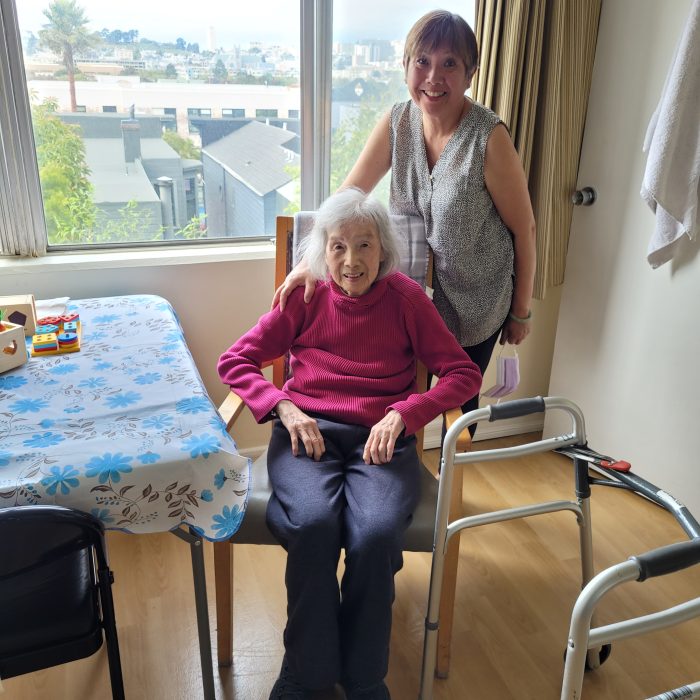
“It was quite a change for a woman who was “very social” and whose life was immersed in family and friends, said Karen Yee, her oldest child. “She was a wonderful cook. Whenever I was invited to a potluck, I’d ask mom to cook something special. Her food was always the hit of the party. Dad was a butcher; on Thursday nights we’d have prime rib and all the relatives would come for dinner.”

Once in hospice, Lee mostly slept. But up until then, her life was still filled with family and regular card games. Yee, who said she was “connected at the hip” with her mother, stopped by three afternoons a week and stayed through dinner. Lee’s other children and relatives also visited frequently.
Lee was among the many adults over 80 – one in three – who aren’t able to stay at home without assistance as they age, a trend that’s expected to continue, according to a January report by the Public Policy Institute of California. But both in-home care and assisted living facilities are costly, leaving many seniors dependent on assistance from family for care or supportive housing. The poor can get in-home care or a space in a nursing home through Medi-Cal.
Charges at Victorian Manor range from a $5,000 to 6,000 a month for a shared room with a toilet and vanity, services and meals, to a high of $9,000 to $12,000 a month for a single room, which is what Lee has. Residents who need skilled nursing care or who have severe behavioral issues, neither of which the facility is equipped to provide, are referred to other facilities.
Yee noted that there’s a call button on the wheelchair Victorian Manor provided her mother. At the previous facility, she said, “the only call button was on mom’s bed. When she fell out of her wheelchair and cracked a rib, she lay there until someone noticed her on the floor.”

Lee immigrated from China in 1945 at 18, following an older sister already settled in the Bay Area. For the first months, she lived at Cameron House, established in 1874 as a house of refuge for Chinese girls and now a multi-service nonprofit. Eventually, she moved to Gum Moon Women’s Residence. “Her friends from those days are still her friends today.
Party dresses and presents
Mom was a giver; she could never say no, Yee added. “After taking care of her own family, she’d travel from San Francisco to Berkeley to help her sister with her five children. And she always volunteered at Cameron House, she called
Once Lee developed rudimentary English skills, she went to work. One of her first jobs was with an American family with a young son. “That’s where my mom learned about how Americans celebrate birthdays and Christmas. She always made sure we had party dresses and presents, and cupcakes with candles for our birthdays.”
Later, she began working at the Bank of America, where she remained for 30 years in the check-sorting department.
Though she was the oldest child, Yee did not marry until she was 35, so she and her mother spent many Friday nights together. “We’d eat pizza and drink white wine. Mom liked her white wine,” Yee said. When Yee retired and before her mother moved into assisted living, they would go to Spreckel’s Lake to watch the ducks before having lunch out. “We were close,” Yee repeated.
Lee’s favorite activities were mahjong and cooking, Yee said. “They’d start the game on Saturday, play till late at night. My aunt would stay over, sometimes other people would, too and they’d just start playing again on Sunday morning.”
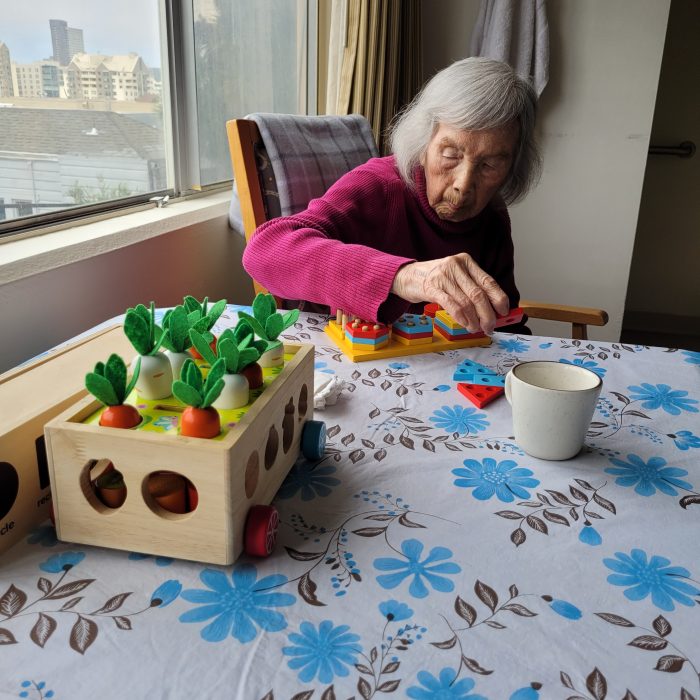
Even as her mind was going and she was becoming more frail, she continued playing mahjong. On Sundays Yee, her nephew and his wife joined Lee at the Victorian for an afternoon game, which were “the highlight of mother’s week,” Yee said.
Loss of language
With time, Lee’s hearing worsened until she could neither comprehend nor speak English. The loss of second language is not so unusual. The frontal regions of the brain, which are involved in language acquisition, can be affected by dementia.
“Mother didn’t want to move into a facility; she wanted to live with me. But I was still working at Bank of America, and we couldn’t handle it,” Yee said. So, after some discussion, Lee was moved into a facility on Van Ness Avenue.
The family wasn’t particularly happy with its ”point” pricing system, used in many assisted living facilities, which tags on an extra fee each additional service not included in the resident’s initial care plan.
When Lee was incontinent, for example, Yee said, “they charged us $150” each time they had to wash the carpet. “They charged for a haircut when she didn’t need one. When we asked them to bathe her more than once a week, they charged extra.” Extra changes of clothes and diapers also brought new fees. “We never knew what they would charge,” she said.
The biggest extra charge they received was $1,200 sundowners’ fee,” care for the agitation dementia patients often experience when the sun goes down.
“Finding a good, assisted living facility is hard work. You’ve got to do your homework. There are so many questions to ask,” said Yee, who eventually piggy-backed on the research done by the families of other residents. “In the end, nine of us moved our family members to Victorian Manor.”
Yee was happy with the new place, particularly because there’s point system, no surprise costs. “The cost you’re quoted is the cost you pay,” Yee said. “As additional services are needed, the family and facility develop a new contract.”
Her mother liked the staff, who came to feel like part of the family. Yee said she always felt welcome and appreciated. “They’ve even turned to me for help in talking with some of the other Chinese residents.”