

Couple beat ‘fast furniture,’ pandemic and other challenges to keep upholstery shop going for nearly 50 years
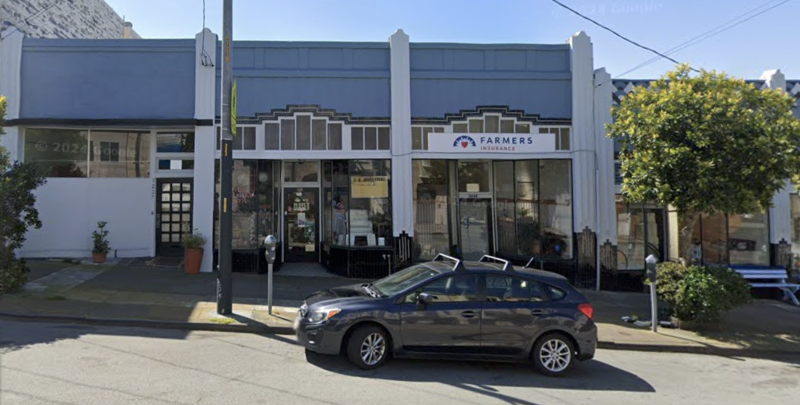
J & G Upholstery stretches back farther than it looks from the sidewalk on Balboa Street. Stacks of yellow foam wrapped in plastic sit along a wall and rolls of fabric line the shelves as chairs in different stages of repair rest on worktables with their springs exposed.
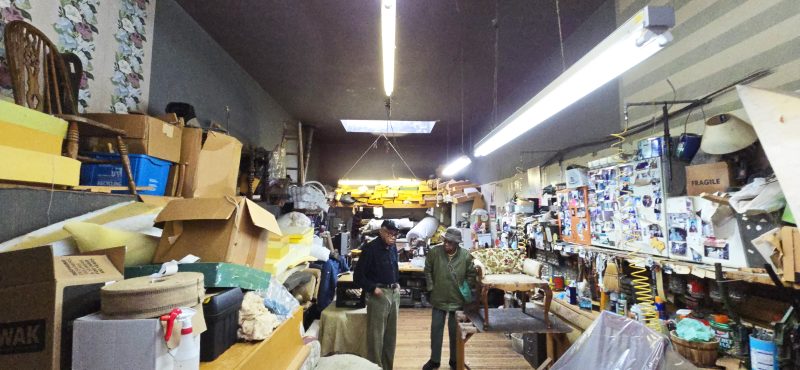
James Ross, 91, stands near the back of the shop beneath fluorescent lights wearing a dark cap, leaning over a wooden frame. His wife, Ginn Ross, 87, dressed in a jacket and hat, moves between the front desk and the worktables, checking on projects and greeting customers.
“It’s a dying art,” James said of the craft he’s been practicing for more than 55 years.
The couple has run the Richmond District shop since Feb. 1, 1978, barely a year after Jimmy Carter’s inauguration. In less than two years, they will mark 50 years in business, a milestone that seemed unimaginable when they first opened.
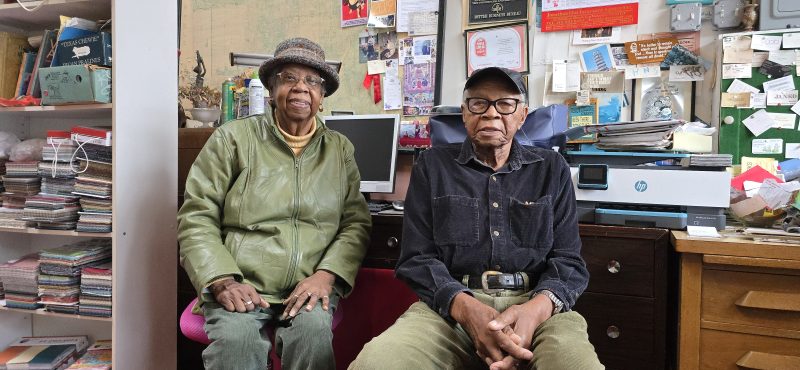
“It is meaningful that we have been able to stay in this area, in this neighborhood, for all those years,” Ginn said. “I didn’t expect that, but here we are.”
For parts of seven decades, J & G Upholstery has been restoring older furniture, preserving a craft that few are pursuing in today’s world. They’ve survived gentrification, economic downturns and the proliferation of “fast furniture,” along with their own health challenges and the pandemic.
A chance meeting
The pair met at a party in 1968 in the Fillmore on Fulton Street. It was “loud,” Ginn recalls.
James had stopped by to check on the party’s host, Rosemary, a close friend of Ginn who was married to his cousin. James hadn’t been invited but occasionally checked in on Rosemary while the cousin was.
“He didn’t know there was a party,” Ginn said.
She remembers wanting to dance. “He couldn’t dance,” she said, laughing.
“Two left feet,” James admitted.
They married in 1970.
James, who was born in McComb, Mississippi, moved to San Francisco in 1947 and attended Galileo High School. Ginn went to Washington High School in El Dorado, Arkansas, before eventually making her way west. They never had children.
Two years after they married, James began working as an upholsterer in San Anselmo. He had previously worked for a moving company. “My father told me, learn a trade whether you use it or not,” James said.
James didn’t initially like upholstery, but he stuck with it. “I learned from the bottom up, putting on webbing, tying springs,” he said. “I tell people, ‘I went to college.’ You learn when you work around different people, all you’ve got to do is listen and watch.”
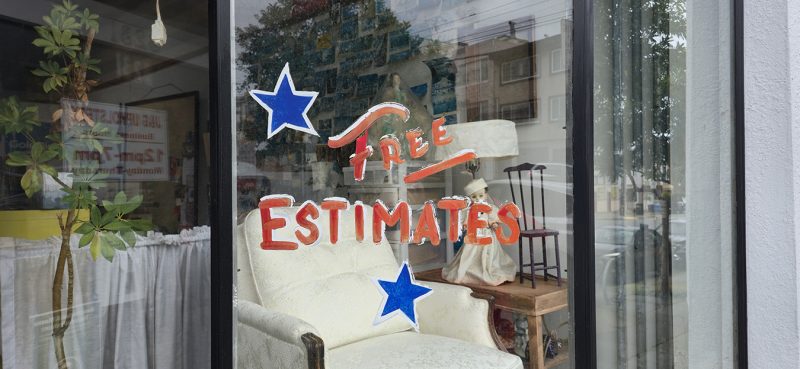
In 1978, the couple took over the Balboa Street shop, which had already been an upholstery business for a few years. The “Free Estimates” sign on the front glass was hand-painted their first year in the shop.
James describes upholstery as precise work that takes years to master.
“You’ve got to be patient,” he said. “Eight to 10 years.”
Precision matters
One wrong cut can ruin a piece of fabric, he explained. A frame that isn’t solid can’t be saved. “The frame is what matters,” he said.
Much of the furniture they work on is decades old.
“People are beginning to realize the older furniture is the best furniture they could get,” James said. “The newer stuff is nothing but particle board.”
The business has had slow periods over the years, and Ginn acknowledged it wasn’t always clear it would survive the pandemic. “We were a little skeptical,” she said.
But customers returned, and the shop is now backlogged with work.
“Every day we get something,” Ginn said.
“Around the holidays, that’s when we get most of our customers.”
The business has a 4.9-star rating on Yelp.
“James is a master craftsman,” a Yelp reviewer who ordered multiple pieces of reupholstery wrote. “I don’t believe you can find someone as experienced and skilled as him anywhere else in the Bay Area. Ginn takes good care of their customers.”
The Richmond District has changed dramatically since they opened. Ginn remembers seeing a handful of Black families in the neighborhood in the late 1970s, of which few remain.
The Rosses have navigated the complicated realities of running a Black-owned business. Ginn said there have been some upsetting incidents over the years but declined to comment on the specifics. “You can just say there were hurtful moments,” she said.
The Rosses understood early on that they would have to show they belonged, and they proved themselves by carefully restoring furniture and completing projects on time.
Ginn said she chose to view the disconcerting encounters they’ve experienced as ignorance.
“There are good and bad in every race,” she said. “You have to roll with it.”
Ginn said she and her husband have largely been treated well by the community over the years, noting that staying in business as long as they have isn’t something she and her husband take lightly.
“I’m surprised we stayed here this long,” she said.
Their longevity has not gone unnoticed.
“James and Ginn at J & G Upholstery are a beautiful testament to partnership and perseverance,” said YaVette Holts, founder of the Bay Area Organization of Black Owned Businesses.
“Not every success requires innovation or technology. Their nearly 50 years in San Francisco are built on craftsmanship and care. It speaks volumes about their commitment to serving the community. They’ve survived revitalization and gentrification and continue to be a beacon of excellence for the neighborhood and the city’s Black culture.”
Health challenges
Their partnership has extended beyond the shop floor.
A few years ago, Ginn was diagnosed with breast cancer. Later, she faced kidney cancer. She was out of the shop for about two months following surgery. “I’m really proud of him,” she said of James, who kept the business running during her recovery.
James downplayed the challenge. “I made it okay,” he said.
James has faced his own health concerns. Doctors once recommended knee and shoulder replacements. He declined. “I stand up all day,” he said. “It doesn’t bother me too much.”
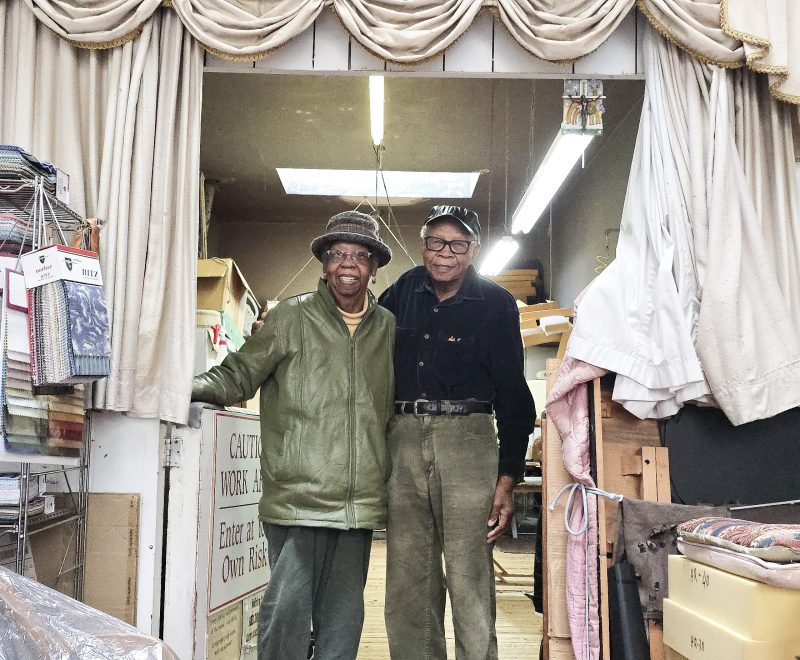
He still does physically demanding work, including tying springs by hand. Asked how he has managed to continue the physical work into his 90s, he shrugged. “I can’t explain that one,” he said. “I used to work for a moving company. Got pretty good muscle.”
Both credit mindset as much as anything. “If you think old, you’ll feel old,” Ginn said. “It’s a mind condition,” James added. “You’ve got to put that in your mind and go do it.”
The couple commute four days a week from Vallejo, where they moved after finding a more affordable home. The drive gives them time together before and after work.
They keep their satellite radio on most of the way. “BB King, Marvin Gaye, Sam Cooke, Johnny Taylor,” James said. “We just do that on the way home and on the way to work.”
Customers come from across the Bay Area from as far as Marin, Moraga and the Peninsula. Some have returned after decades.
“A lady called the other day,” Ginn said. “Said, ‘You did work for me 20 years ago.’”
Sawdust
Asked how he feels about “fast furniture” commonly sold online and at big box outlets such as IKEA, James said “a lot of it isn’t even wood. “It’s particle board.
“Do you know what particle board is?” he asked. “It’s sawdust.”
He shrugs when asked if he works on it. “There’s nothing we can do for that,” he said.
He prefers working on older furniture, the kind built with solid frames built to last that can be repaired and recovered instead of replaced.
In the shop, photographs from decades past, a 1970 map of San Francisco, and faded 49ers posters fill the walls. In the back, beneath fluorescent lights, he leans over a frame, working methodically.
Nearly 60 years have passed since that party on Fulton Street. Sometimes, Ginn thinks about how it all unfolded. “It’s remarkable,” she said.
James still can’t dance, but he still shows up on Balboa Street.