

Former SFSU teacher shifts to helping union workers build leadership abilities
Like some people need coffee, Joan Wong needs to walk – and talk. Mornings, she puts in two to three miles a day up and down the hills of Glen Park Canyon near her home. Afternoons, you’ll find her strolling the neighborhood with her dogs, greeting friends, and chatting up strangers.
But her superpower, she said, is listening, a talent learned from her parents, honed with her siblings, and perfected over years of parenting, teaching university students, and now union professionals.
On Tuesday, Thursday, and Friday afternoons, Wong ditches the T-shirt for a “nice blouse,” hunkers down over a laptop in her garage, which is filled floor to ceiling with her books and her husband’s comics collection, and logs into Zoom.
Her task: A lot of listening as she helps union organizers and staff improve their reading, writing, and speaking abilities – in an effort to develop their leadership capabilities.
“It’s not just the words; it’s the way they present themselves, the way they react to something. When somebody sighs when we’re going over the vocabulary, then I know, OK, I need to think of another way to help them get through this.”
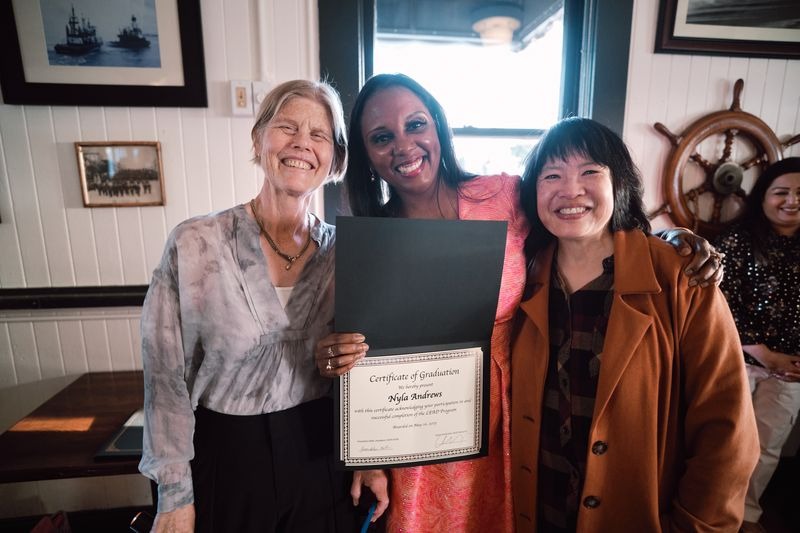
Wong, 68, is in her fourth year as an online tutor for The LEAD Project, a training collaboration between Compose, an organization founded by San Francisco State University educators and UNITE HERE, a labor union that represents workers – mostly women and people of color – in the hotel, gaming, food service, airport, textile, manufacturing, distribution, laundry, and transportation industries in the U.S. and Canada.
‘Right up my alley’
Having retired this past spring from her career as a lecturer of English Composition at the university since 1995, Wong said she had to switch her mindset from teaching first-year college students to working with adults who may not have had as many opportunities to read and write.
“College freshmen arrive geared to learn,” she said. Most have had high school preparatory courses in academic writing and reading comprehension. Her LEAD students are engaged in demanding union careers, few have pursued any type of higher education, most are raising children, and many do not have English as their first language.
They make up for that with determination, she said.
“I am working with adults who really want to learn; we’re improving literacy and self-confidence, and those skills are right up my alley,” she said.
Tutoring the same person one-on-one on Zoom over a year creates strong bonds, even long-lasting friendships. About an hour before her tutoring session, Wong prepares by reading the week’s class notes and rereading her last session’s notes, including emotional insights she picks up during sessions. “The question is, ‘How do I meet them where they are?’”
Wong says she has to listen more because, “although I’m familiar with the psychology of 18-year-old students, union people have full lives – they bring a lot of life experience that is invaluable to the learning process, so I’ve learned to listen carefully and let each person’s goals determine what I teach.”
The union workers she meets exhibit a commitment she finds inspiring. “They are passionate about helping others. They give up part of their lives so that we can live in a democracy.”
Wong was born in 1957 in the family home on 12th Avenue and Balboa in the Richmond District. She was barely one year old when tragedy struck. “Here’s the hard part,” she said, “I never quite know how to say this.” Because she was so young, Wong’s parents didn’t tell her she had an older brother who died.
Keeping bad things secret
“Even as I grew older, they said very little and I knew better to ever ask for more information – it may sound strange to hear, but I think it was part of their Chinese culture and generation to keep bad things a secret. It was so painful for them, a subject we knew was off limits. To this day, I don’t really know what happened.”
“What I do know is that my parents absolutely loved being parents,” Wong said. “They really loved having kids.”
Fifteen months after her brother’s death, a sister came along, then a brother who is three years younger, and later, a sister who is seven years younger. “So much went unsaid in our family but it was always my parents’ expectation we be kind to each other, that we support and help each other, and your family always comes first.”
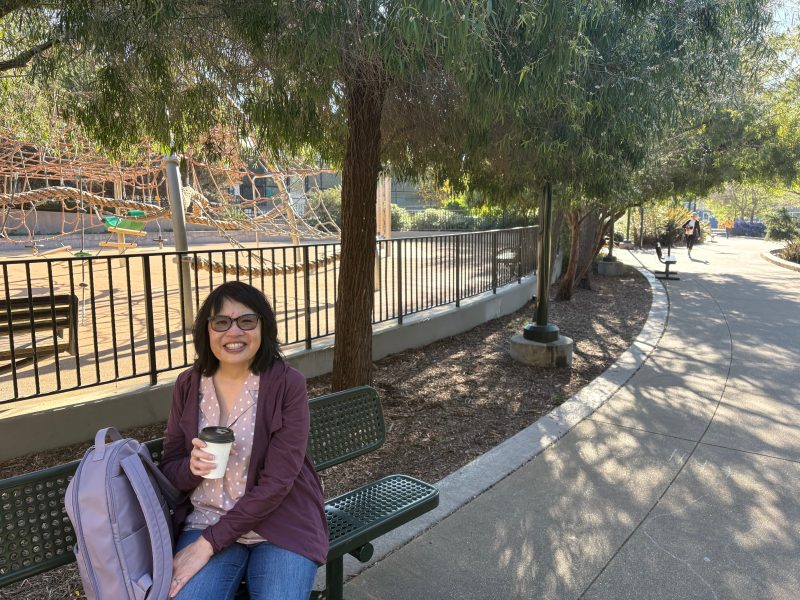
It was only when she was raising her own daughter, Wong said, that she realized her parents made this choice out of love for her and her younger siblings.
Yet, she said, “My path to parenthood and my parenting choices couldn’t have been more different.”
Before China’s one-child policy officially ended on January 1, 2016, it fueled a massive international adoption wave of abandoned Chinese girls, peaking in the 1990s and 2000s. When Wong and her husband Michael were ready for children, it turned out to be very difficult for her to conceive, so they embarked on the long process of adopting a baby girl in China.
Most of the adopters in Wong’s group of 2002 were Anglos, many from California,and a few from Florida and other states. A handful were Asian.
“We were in China for two weeks, and it was a pretty intense experience for everyone. Then, when we returned to the U.S. with our baby girls, our group met for a number of days with the adoption agency to go through mountains of paperwork.”
A family of adoptees
They shared every meal together during this time. “We opened up about our parenting concerns, our hopes for our baby girls, and exchanged tips on how to do simple things like feeding a baby – it was our first time for everything, and we were all there to help each other.”
Wong says there was a mutual desire among the group to stay connected for their daughters, and thanks to social media, her daughter Mari and many of the girls are still in touch.
As Mari was growing up, Wong said, “I made a conscious choice to be open about her adoption, why we adopted, and the process. We have always been open with her about everything in our family. Let’s just say she was raised to say what is on her mind and she does not hesitate.”
Wong recites something she heard at a workshop for new teachers: You don’t have to like all of your students, but you have to love all of your students. It wasn’t until she became a parent that she truly got it, she said.
“My daughter marches to the beat of a different drummer; she tends to ask a lot of questions, which I think is good, but it drives people crazy,” she said. “I want people to love her enough to see her strengths and build on those strengths.
“Like my parents, I really love children but after having my daughter Mari, as I thought about it, I said, ‘Oh, that early experience is why I’ve become this nurturing person.’ “
Mari, now 24, is a student in the paralegal program at the University of California-Los Angeles and an accomplished ballroom dancer. Now that Wong is retired, she relishes the opportunity to drive with her sisters to Los Angeles and other cities where her daughter participates in competitions.
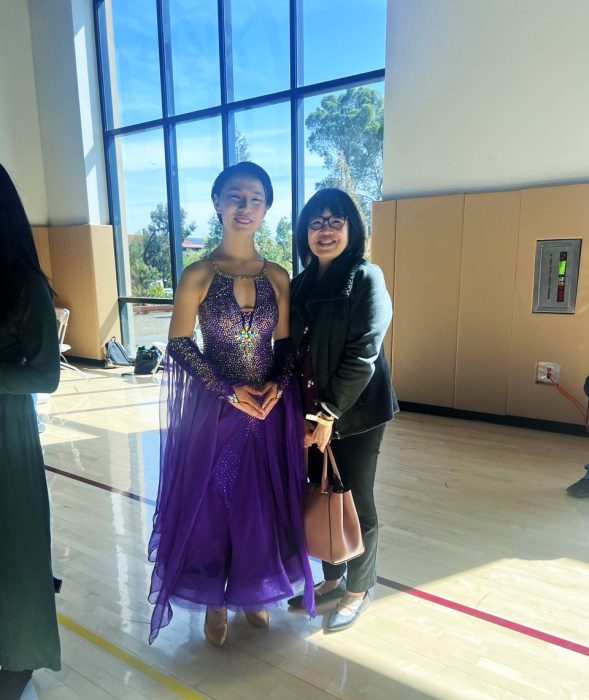
“My daughter has always had her own strong interests and so while my husband and I guide and love her, she gets to choose,” said Wong, “except when it came to learning Mandarin.”
She believed the ability to speak Mandarin would be essential to both her daughter’s self-perception and her identity. “We have an ongoing conversation about how speaking Mandarin has opened doors to experiences which might have been closed to her.”
Her daughter’s ability to speak Mandarin, for example, gave her an advantage during a summer film program in China she attended as an undergrad at Loyola Marymount University, Los Angeles. Required to make a short documentary about some aspect of life in the country, Mari focused on a woman who made traditional taro cakes. Though her Mandarin was rudimentary compared to that of the native speakers she met, they were more open with her than the other film students, Wong said.
Language as identity
Another reason Wong placed her daughter in Starr King Elementary’s Chinese immersion program: “I didn’t want her to be like me.” Wong, who is American-born, said what she and the other Chinese-American kids did in Chinese school was, “we socialized. We didn’t do our homework and the language didn’t stick. So, it’s like Mandarin skipped my generation.”
While working on her teaching degree at SFSU, Wong joined the Multicultural Alliance on campus, which placed student teachers in private schools. “This was the mid-80s when private schools were doing a big push to diversify their faculty. I was teaching part-time at the San Francisco Day School, and we were the first instructors of color at the school.”
From day one of teaching, Wong learned being Asian was important to her students. Every semester, someone would tell her, “I never had an Asian teacher teach English” or say, “You’re the first teacher of color that I’ve had.”
For Wong, being “the first” is part of a family tradition. “When I was growing up, my father worked for RCA in the electronics division,” she said. “We moved to Fremont before I started first grade because he got a management job. At that time, he was the first Asian person to get a management position, and he was always really, really proud of that.”
It was easier for her than her father, she said, but there were moments of challenge. “I guess nowadays we call those micro-aggressions, but that’s the way life was. Parents would ask me where I learned to speak English or they would say, ‘You speak English so well,’ or ‘You must have studied really hard.’ “
The best part of being in a classroom with students, Wong said, is trying to figure out what makes them tick. “What can I do to motivate them? I really loved that interaction with my university students.”
Union gains a fan
It’s the same with her LEAD students. But she said she had never really appreciated union work until meeting the people involved.
“I’ve known about unions my whole life because when my father started out, he was in the engineers’ union and, of course, when I began teaching, I joined the teachers’ union,” Wong said. “But I wasn’t really involved, never walked a picket line, didn’t really think about how it might have helped my father and me.’’
She remembered how one of her tutees, a charismatic union organizer and union local president, found a way to build bridges with different cultures. An African American, he told her he struggled during his youth in Washington D.C., that if you had met him, you would have never expected him to succeed. Yet he did. “His whole life now is about lifting others up,” she said.
And, if not for The LEAD Project, she said, “he’s someone I’d never have met.”
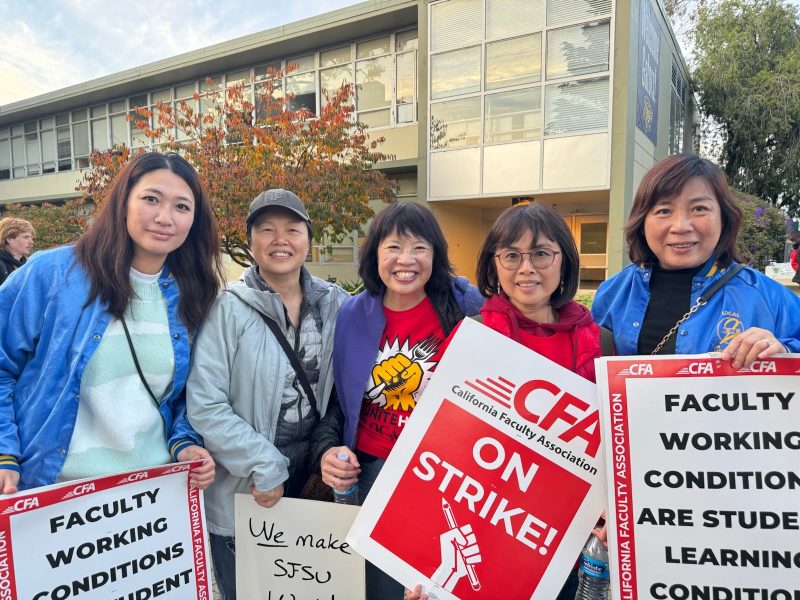
In Spring 2024, Wong took part in her union’s strike at SFSU, joined by three LEAD Project tutees from Local 2. “Because of the many union people I’ve met, I know they are the backbone of our democracy. I only wish they might organize us all.”