


As a teacher, playwright & screenwriter, Cary Pepper has lots of inside Hollywood info to share
You probably stream most of your movies. But if you happen to rent a film on old-style VCR or DVD, take a moment to read the description on the back of the box.
There’s a good chance the words were written by Cary Pepper, an award-winning San Francisco playwright, novelist and lecturer on the history of movies. It wasn’t a glamorous job, but “it was fun. My workday consisted of watching movies,” he said.
That gig was decades ago, and Pepper, now 78, is still writing, having authored some 100 plays, four novels (with another debuting in August) and three screenplays. He’s taught writing and film appreciation at the Fromm Institute, the Osher Lifelong Learning Institute, and San Francisco State University.
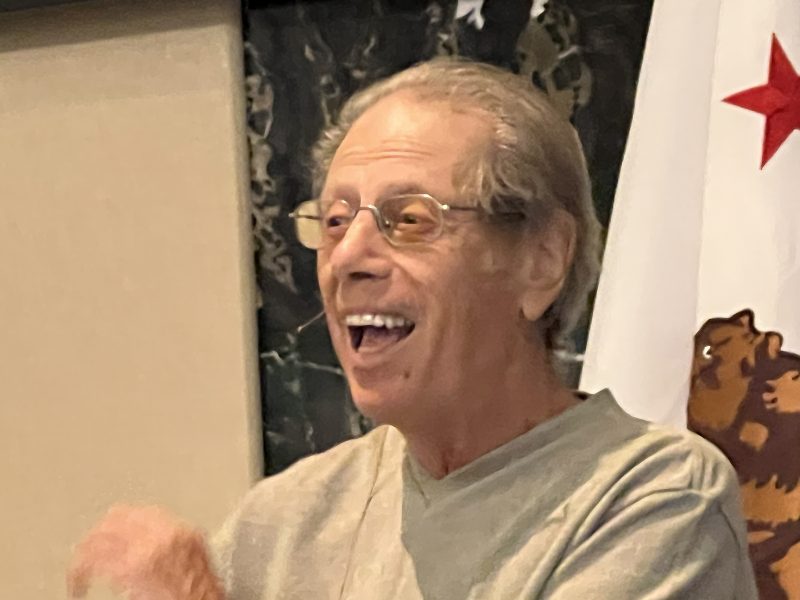
His sandy hair is thinning, and he just underwent cataract surgery, but he’s trim and fit-looking, in part a tribute to his habit of playing pickleball three days a week.
Long hours at the keyboard are still the norm for Pepper. “I set a goal of what I want to accomplish that day,” he said. “If it’s a full-length play, it might be a scene; if it’s a 10-minute play, it’s getting through the next draft of the play. If it’s a novel, I might be writing one chapter. I’m capable of sitting at a computer for five hours and working steadily.”
Maybe it’s because our collective attention span has been lowered by social media, very short plays, sometimes just 10 minutes in length, are in vogue. Pepper has always liked the short form, and he’s known for his mastery of extreme brevity.
“It can be harder to write short than long, but you have an instinctive feeling for the structure when you do,” he said. “The reason I like them so much is that I’ll sometimes come up with an idea that’s not big enough for a full-length play but works well for one act.”
“Small Things” won the Tennessee Williams/New Orleans Literary Festival One-Act Play Contest in 2006 and is one of his best-known works.
‘What if’ inspires his work
Accidental encounters are a frequent theme of Pepper’s. “I often like to ask, ‘What if,’ he said. In “Small Things,” a middle-aged man who has lost his job is alone in his apartment contemplating suicide when a 19-year-old door-to-door evangelist knocks on the door. They begin a dialogue about faith, despair, meaning, and human connection.
Some of his very short dramas have been produced by Drama with Friends, in association with the Community Living Campaign.
Pepper was born in Brooklyn, New York. His father was a toy salesman; his mother a school secretary. He has one brother. “It was a normal middle-class upbringing,” he said.
Writing has long appealed to him. “I always found that writing came very naturally to me, and I wrote a lot of fiction in junior high and high school.”
Following his mother’s advice to pursue a career offering more stability than writing, he entered Brooklyn College with the intention of studying medicine. “But when I took my first chemistry class, that put the kibosh on anything related to studying science.” He switched to English literature, graduating with a bachelor’s degree in 1970.
While an undergraduate, he took a class in playwriting and was told to write a three-page play. He doesn’t remember the title but recalls that it “was rather absurdist; I’d been influenced by Samuel Beckett.”
A lifelong fascination with classic movies began at a frat party. Some of the guys, he recalls, were partying hard so he decided to go upstairs where a movie was being shown. It was “Treasure of the Sierra Madre.” “Something clicked,” and he became a film buff. Even today that movie and “Casablanca” remain two of his three favorite films. The third: “It’s a Wonderful Life.” He finds it interesting that all of his favorites are black and white but has no explanation.
Six years teaching high school English followed graduation.
Ready to start a new career, he quit and began to work as a freelance writer and copywriter. “When I would meet people at parties and stuff, they would say, ‘What do you do?’ I’d say I’m a writer. They’d say, ‘What do you write?’ My standard response was I write (nonfiction) for the landlord, but I do fiction for myself.”
He met his future wife, Laura Koehler, while living in New York, and the couple decided to move to the West, landing in San Francisco in 1989. They made a pact. Since she had stayed in New York to be with Pepper, he would agree to give San Francisco a try for at least five years. It worked.
They’ve been married for 35 years and still live on the west side of San Francisco. Koehler retired after a career as a hospice social worker. They travel frequently and on many Sundays cruise the Bay on their 30-foot sailboat, the Jonathan. They have no children.
Film chops leads to job
While grinding out magazine articles for a living, Pepper got another serendipitous push to a movie-focused career. He was playing badminton and chatting about movies with another player. The man was so impressed with Pepper’s knowledge of film, he offered him a job: writing copy on the back of video rental boxes.
He began to focus on more substantial projects and had some early success in New York, where five of his plays were produced in a span of just three years in the 1970s. Success is never assured when a writer submits a play, but “a piece might be rejected, and in just a little while I’ll hear from someone else who wants to produce it.”
His plays have been honored with more than 20 awards since 1976, but none of his screenplays have been produced, a source of mild frustration. But taking a cue from his wife, he said, his outlook has been: “Don’t project and take things a day at a time.”
Pepper’s classes on films are popular. He’s recently taught classes on film noir, the movies of Kathryn Hepburn and Jimmie Cagney. Later this year he will be focusing on the films of Alfred Hitchcock at the Fromm Institute.
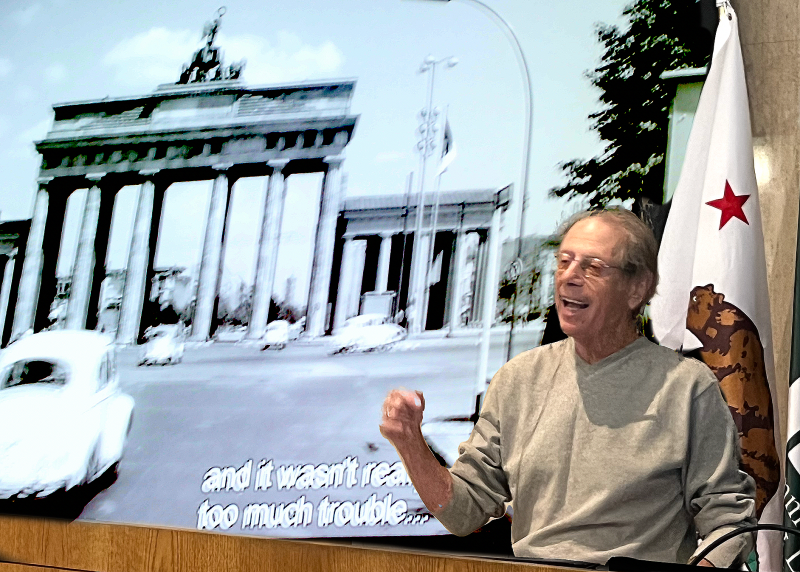
He generally wears collarless shirts when he lectures and takes off his glasses to read from notes. His talks on films are stuffed with details about the production, its stars and director, and the studio that produced it. And he has a store of inside Hollywood gossip and lore.
Jimmy Cagney, Pepper recounts, was once the target of a proposed assassination attempt by the mob. Cagney, whose left-wing sentiments were well known, helped found the Screen Actors Guild. Angered by a threat to its influence over the Hollywood labor market, gangsters hatched a plot to kill the film star by dropping a klieg light on his head.
But George Raft, a friend of Cagney’s and a film star known for playing heavies, stepped in. Raft, who allegedly had ties to the mob, persuaded the gangsters to call off the plot, Pepper said during a class on Cagney’s films.

Pepper works hard at his teaching, spending hours before each class looking for snippets from each film to accompany his lecture and add insight to the session.
He can be a bit obsessive about films he loves. Early in his teaching career, he hosted an eight-session class on “Casablanca,” and planned to have students watch the film eight times. But he was persuaded to limit the required viewings to just one or two.
He likes the “Maltese Falcon” so much he wrote “Reel Life Crime,” a novel which, he said, “mirrors the plot of Dashiell Hammett’s story (and John Huston’s film), while being an original mystery in its own right.”
His latest novel, “Autokill,” has a title that seems to foreshadow a grim future, but that’s not the case, he says. “It’s a novel of ideas and a techno-thriller set in a future that’s already here.”






Jim Breivis
Bill Snyder has captured the essence of Cary Pepper and his excellent teaching about movies. Specifics about the featured star including relationships with the producers, directors, fellow actors both related to the featured movie or personal lives together create a classroom experience that is wonderful.